
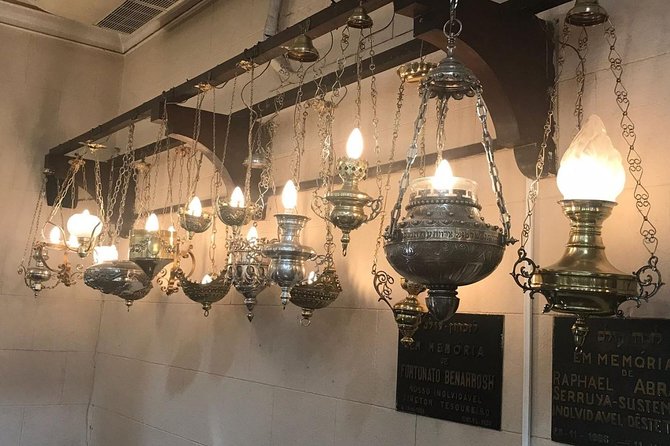
Reviewed · HISTORICAL TOURS
Rio Jewish Heritage Half-Day Tour
Rio’s Jewish story is hiding in plain sight. This three-hour tour connects Park Yitzhak Rabin and its Sugar Loaf views with Jewish museums, schools, squares, former businesses, and synagogues across the city. I like the way it links Jewish life to Rio’s streets rather than treating history as something locked indoors. I also like the mix of Sephardic, Ashkenazi, and Orthodox sites. The main drawback is that the pace is tight, and entrance fees are extra.
The air-conditioned car or minivan, hotel pickup, and small group keep the outing easy to manage. Guide Leonardo has earned special praise for bringing both his own story and Rio’s Jewish past into the conversation, so ask for him if he is available. Keep in mind that at least two people are required to book, and synagogue visits can change with availability or your request.
In This Review
- Key points to know before booking
- Why this short tour adds another layer to Rio
- Starting at Park Yitzhak Rabin above Botafogo
- On the road to downtown: names, schools, and commerce
- The Jewish Museum and the Grand Temple
- Shel Gmelut Hassidim and the Sephardic story
- Copacabana’s Jewish institutions
- Possible synagogue changes and different Jewish rites
- What $99 includes, and what it does not
- Who will get the most from this experience
- How to prepare for the three-hour route
- Should you book the Rio Jewish Heritage Half-Day Tour?
- FAQ
- How long does the Rio Jewish Heritage Tour last?
- What languages are available?
- Is hotel pickup included?
- What type of transport is used?
- What is the price of the tour?
- Are entrance fees included?
- Can the synagogue visits change?
- Is a kosher lunch available?
- Can I cancel for a full refund?
Key points to know before booking
- Park Yitzhak Rabin opens the tour with a superb view: You look across Botafogo Beach toward Sugar Loaf while learning why the park carries the Israeli leader’s name.
- The route covers several Jewish traditions: You may see Sephardic, Ashkenazi, and Orthodox Chasidic congregations, giving the tour useful range.
- The Grand Temple dates from 1932: Its age and architecture make it one of the most significant stops downtown.
- Leonardo is a major strength: His personal connection and clear command of the subject can turn a short tour into a memorable lesson.
- Extra costs are modest but real: The Jewish Museum costs $3 per person, and the Grand Synagogue requests a $6 Tzedakah contribution.
- This is a compact overview, not a full-day study: You get a smart introduction to Jewish life in Rio, but not long visits at every location.
Why this short tour adds another layer to Rio
Rio is often presented through beaches, viewpoints, samba, and colonial churches. Those are important pieces of the city, but they are not the whole picture. Jewish families and institutions have also shaped Rio’s neighborhoods, schools, religious life, and commerce.
I like this experience because it gives you a different way to read the city. You are not only moving from one religious building to the next. You are seeing how a community established itself in public spaces, created businesses, built schools, and maintained different religious traditions.
The three-hour length works well if you want a focused introduction without giving up an entire day. You will not get a long seminar at each stop. Instead, the guide has to connect the points quickly, explain what matters, and help you understand how the locations fit together.
That makes the guide especially important. Leonardo has been praised for his passion, personal story, and advice about Rio. His role is not just to drive you between addresses. He helps turn a list of buildings into a human story about Jewish life in another country.
More Historical Tours in Rio de Janeiro
- Rio de Janeiro: Historic Rio and Santa Teresa Half-Day Tour
★ 4.4 · 228 reviews - Rio de Janeiro: Little Africa Heritage Walking Tour
★ 4.9 · 177 reviews - Explore Little Africa : Unveiling Afro Heritage in Rio de Janeiro
★ 5.0 · 97 reviews
Starting at Park Yitzhak Rabin above Botafogo
The tour begins at Park Yitzhak Rabin, where you get privileged views over Botafogo Beach and Sugar Loaf. The park was inaugurated by Lea Rabin, Yitzhak Rabin’s wife, which gives the stop a direct link to modern Israeli history.
This is a smart opening. You begin outdoors, with one of Rio’s famous views in front of you, before moving into the city’s religious and cultural sites. It also gives the guide a natural chance to explain the connection between Brazil, Israel, and the Jewish community in Rio.
Bring your camera, but pay attention to the explanation too. The view is the easy part to remember. The point of the stop is understanding why a park in Rio honors an Israeli prime minister and how that fits the broader story of Jewish identity in Brazil.
Because the tour is short, your time here may be limited. If you want a long pause for photographs, you should tell the guide early. The schedule needs to keep moving.
On the road to downtown: names, schools, and commerce
The drive toward downtown adds several small but meaningful references. You pass Chaim Weitzman Square, named for Israel’s first president, and a public school named after Anne Frank.
These are not grand attractions, and that is precisely why they matter. A square and a public school show Jewish names appearing in everyday civic life. You are seeing public recognition, not only private religious practice.
The route also passes through Catete, a neighborhood where Jewish residents once established a successful furniture trade. That detail gives the tour an economic angle. Communities are built not only through synagogues and ceremonies, but through shops, work, family networks, and local businesses.
You should expect these points to be viewed from the vehicle or treated as brief stops, rather than full visits. Still, they help you see Rio as a city shaped by many communities. I find this part particularly useful for anyone who wants social context, not simply a collection of impressive buildings.
The Jewish Museum and the Grand Temple
The Jewish Museum offers the tour’s clearest indoor look at Jewish life in Brazil. Admission is not included, and the stated entrance cost is $3 per person.
That small fee is easy to overlook when planning, so keep a few extra dollars available. The museum gives the guide a place to explain people, traditions, and events with more structure than is possible during a drive. Since the entire experience lasts only three hours, your visit may be selective rather than leisurely.
Next comes the Grand Temple, a beautiful building from 1932. Its age gives it a strong place in the route, and the architecture helps show how established Jewish institutions became in Rio.
The contribution requested at the Grand Synagogue is listed as $6 per person under the term Tzedakah. This is separate from the tour price. The amount is not large, but the wording matters: you should treat it as an additional contribution rather than assume it is included.
Dress appropriately for the museum and religious sites. That is both practical and respectful. Synagogues are working religious places, not just historic buildings, and access may depend on what is happening there that day.
More history-led tours:
- Learn the History of Rio with an Unforgettable City Center Walking Tour
★ 5.0 · 82 reviews - Rio’s city walking tour: a glimpse of history and olympic legacy
★ 4.5 · 78 reviews - Olympic Boulevard, Museum of Tomorrow & Historical Rio
★ 4.5 · 66 reviews - Rio: Olympic Boulevard, Museum of Tomorrow & History Tour
★ 4.1 · 47 reviews
Shel Gmelut Hassidim and the Sephardic story
The Synagogue Shel Gmelut Hassidim, located in Botafogo, follows the Sephardic Jewish Spanish rite. It is one of the tour’s most distinctive stops because it adds a clear cultural and liturgical difference to the route.
The synagogue has also received a visit from Emperor D. Pedro II, an unusual detail that connects Jewish religious life with Brazil’s imperial past. Your guide can explain why that visit matters and place the building within Rio’s wider story.
This stop is valuable because the word Jewish does not describe one single tradition. Sephardic, Ashkenazi, and Orthodox Chasidic communities have different customs and histories. Seeing one of those traditions in an actual synagogue gives the subject more shape than a general museum explanation.
Access can vary. The tour information notes that synagogue visits may be changed according to your request or availability, so you should not assume every listed building is guaranteed on every departure. If Shel Gmelut Hassidim is especially important to you, mention it when booking and confirm again with the operator.
Copacabana’s Jewish institutions
In Copacabana, the route visits the Club Israelita Brasileiro and Beth El Synagogue. These stops show Jewish life beyond formal worship.
The Club Israelita Brasileiro is a useful reminder that community institutions often include social, cultural, and civic roles. A club can be a meeting place, a center for events, and a way for families to maintain identity across generations. Beth El adds another religious setting to the itinerary.
The Copacabana section also shows why hotel pickup and vehicle transport are helpful. Rio’s neighborhoods are spread out, and fitting Botafogo, downtown, Catete, and Copacabana into three hours would be difficult on foot. The air-conditioned car or minivan saves time and avoids the need to work out several separate transport connections.
The trade-off is that you will spend part of the tour in transit. That is not wasted time, since the guide can explain what you are passing, but this is not a walking tour built around long street-level exploration.
Possible synagogue changes and different Jewish rites
Beth Yacov Synagogue in Copacabana, which follows the Eastern European Ashkenazi rite, may replace another synagogue. Beit Lubavitch in Leblon, associated with the Orthodox Chasidic rite, is another possible alternative.
This flexibility can work in your favor. If you have a particular interest in Ashkenazi or Chasidic practice, make that clear when you arrange the tour. The operator may be able to shape the visits around your request, although availability still controls the final route.
It is best to think of the schedule as a guided framework rather than a fixed promise that every site will be entered. Religious buildings have their own schedules and rules. The ability to adjust the route is more practical than forcing a visit that is not possible.
For first-time visitors, the variety is a plus. For someone researching one specific congregation, the need to confirm details in advance is more important.
What $99 includes, and what it does not
At $99 per person, this is not the cheapest way to spend three hours in Rio. The value comes from the specialist subject, private transport, hotel pickup and drop-off, a small group, and a live guide in English or Spanish.
If you tried to connect all these locations yourself, you would need to plan transport, check opening times, identify the buildings, and provide your own background. The tour removes that work and gives you a clear route through several neighborhoods.
Still, the price does not cover everything. Museum admission is $3 per person, the Grand Synagogue requests $6 as Tzedakah, and food and drinks are not included. A kosher lunch can be arranged if requested in advance, but you should not expect one as part of the standard price.
The value is strongest if you care about Jewish history, religious architecture, family heritage, or the less familiar sides of Rio. If you only want famous scenery, the same three hours might be better spent elsewhere. The tour includes a scenic opening, but its main purpose is cultural context.
Who will get the most from this experience
I would recommend this tour to visitors with a personal or academic interest in Jewish life, as well as anyone who has already seen Rio’s best-known sights and wants a more specific subject.
It should suit:
- People tracing Jewish family or community connections in Brazil
- Visitors interested in Sephardic, Ashkenazi, and Orthodox traditions
- Museum lovers who prefer a focused cultural route
- First-time visitors who want hotel pickup and a simple plan
- English or Spanish speakers who want a live explanation
- Anyone with only half a day available
It may be less suitable if you want a relaxed pace, long time inside each synagogue, or a food-focused experience. The route covers a lot in three hours, and that means some stops will be short.
The minimum booking requirement is two people. Solo visitors should check availability before making firm plans. Confirmation is sent within 24 hours of booking, subject to availability.
How to prepare for the three-hour route
Wear respectful clothing suitable for religious sites. Comfortable clothes also make sense because you will move between indoor stops, outdoor viewpoints, and the vehicle.
Ask about the exact synagogue schedule before the day of the tour. The route can change based on availability or your preferences, and advance notice gives the operator a better chance to include the sites that matter most to you.
Keep money aside for the $3 Jewish Museum entrance and the $6 Grand Synagogue Tzedakah contribution. Food and drinks are not included, while a kosher lunch is available only by previous request.
The tour offers free cancellation up to 24 hours before departure, and you can reserve now and pay later. Those terms are useful if your Rio schedule is still shifting, but you should still wait for confirmation within 24 hours before assuming the booking is set.
Should you book the Rio Jewish Heritage Half-Day Tour?
Book it if you want a well-organized introduction to Jewish life in Rio, especially if you value a strong guide and easy transport between scattered sites. The views at Park Yitzhak Rabin, the 1932 Grand Temple, the museum, and the different synagogue traditions give the three hours a good range.
I would be especially interested in requesting Leonardo, whose personal approach has made this tour memorable for past participants. Just remember that this is a brisk overview, not an all-day research visit, and that synagogue access can change.
At $99, the tour earns its price through specialist guidance and convenience. Add the modest entrance costs, dress respectfully, and tell the operator which religious traditions or sites matter most to you. For the right audience, it offers a thoughtful side of Rio that standard sightseeing often misses.
FAQ
How long does the Rio Jewish Heritage Tour last?
The tour lasts three hours.
What languages are available?
A live guide is available in English or Spanish.
Is hotel pickup included?
Yes. Hotel pickup and drop-off are included.
What type of transport is used?
Transport is provided by an air-conditioned minivan or car.
What is the price of the tour?
The price is $99 per person.
Are entrance fees included?
No. The Jewish Museum costs $3 per person, and the Grand Synagogue requests a $6 per person Tzedakah contribution.
Can the synagogue visits change?
Yes. Beth Yacov Synagogue and Beit Lubavitch may replace other synagogues based on your request or availability.
Is a kosher lunch available?
Yes, but it must be requested in advance and is not part of the standard inclusions.
Can I cancel for a full refund?
Yes. You can cancel up to 24 hours in advance for a full refund.
Just added around Rio de Janeiro
- Pedra Bonita Trail: The easiest trail with a beautiful view of Rio★ 4.6 · 3 reviews
- Rocinha Jeep Tour: A Journey into the Soul of the Favela!★ 3.8 · 3 reviews
- Rio: Private, Custom express, Main Attractions!★ 5.0 · 3 reviews
- Rio: Favela Walking Tour of Rocinha with a Resident Guide★ 4.7 · 3 reviews
- Explore Fernando de Noronha: 7-Hour Ilhatour★ 4.9 · 3 reviews
- Rio: Museum of Tomorrow, Yup Star & Olympic Boulevard★ 3.7 · 3 reviews
- Rio: Best Dive Experience All Inclusive Scuba Diving Package★ 5.0 · 3 reviews
- Rio de Janeiro by Air: 10-Minute Helicopter Tour★ 4.4 · 3 reviews
Historical Tours, compared.



Scenic Train ride to historical cities of Morretes and Antonina
Read our review →

From Foz do Iguazu: Triple Frontier Landmark Ticket
Read our review →
Explore Little Africa : Unveiling Afro Heritage in Rio de Janeiro
Read our review →
Downtown-Center History Walking Tour – in English
Read our review →Browse the lists this tour appears in