
Reviewed · SAMBA & NIGHTLIFE TOURS
Salvador: Cultural Night of Capoeira, Samba, and Drumming
The rhythm starts before the show does. This one-hour cultural night brings you into the first Capoeira school in Brazil, founded by Mestre Bimba in 1937, for a lively program of Capoeira, Samba, Maculelê, drumming, live music, and acrobatics. It feels closer to a working cultural association than a polished stage production.
I especially like the historic setting and the chance to see people of different ages and genders take part in Capoeira. I also like that the music, singing, and movement are tied together rather than presented as separate museum pieces. The main consideration is comfort: the room can become very hot, and the performance may feel uneven because it is presented as an organic cultural gathering rather than a tightly rehearsed tourist show.
In This Review
- Five things to know before you go
- Why Mestre Bimba’s school matters
- Getting to Largo do Terreiro de Jesus
- The opening Capoeira roda
- Samba brings the room to life
- Maculelê and the power of percussion
- A performance that does not pretend to be polished
- How much time should you allow?
- Is $30 a fair price?
- Who will enjoy this evening most?
- Practical expectations from start to finish
- Should you book the Capoeira cultural night?
- FAQ
- Where does the cultural night take place?
- How long does the experience last?
- What performances are included?
- Is transportation to the venue included?
- Are food and drinks included?
- Is the experience available in English?
Five things to know before you go
- Mestre Bimba’s school dates to 1937: You are visiting a place linked to the creation of Capoeira Regional, not simply attending a generic dance performance.
- Capoeira is the main event: Expect fast movements, acrobatic exchanges, singing, and drumming in lively rodas.
- Samba and Maculelê add variety: The program moves beyond martial arts into dance, rhythm, and theatrical physical skill.
- The atmosphere is informal and real: Some parts may be stronger than others, but the presentation aims for participation and tradition rather than perfect stage timing.
- The room gets hot: Wear light, comfortable clothes and shoes, and be ready for an energetic hour.
- The price is reasonable: At $30 per person, the experience offers a compact introduction to several Brazilian traditions in a meaningful setting.
Why Mestre Bimba’s school matters
The address is Associação de Capoeira Mestre Bimba, in Salvador’s old center. The school was founded in 1937 by Mestre Bimba, the creator of Capoeira Regional. That detail gives the evening much more weight than a standard cultural show in a hotel or purpose-built theater.
Capoeira has long carried more than physical movement. It combines music, rhythm, athletic skill, alertness, and social exchange. At this school, you are not only watching an exported version of Brazilian culture. You are entering a place connected to one of the people who shaped a major form of Capoeira.
That connection is the strongest reason to choose this experience. If you already know the basics of Capoeira, the setting may be especially meaningful. If you are new to it, you get a clear first look at how movement, percussion, singing, and community work together.
The school is also described as a symbol of cultural resistance and resourcefulness. You do not need a long lecture to understand why the location matters. The evening uses the place itself as part of the story.
More samba nights:
- Salvador: Cultural Treasure – Samba de Roda.
★ 4.9 · 51 reviews - Rio de Janeiro: Beginner Samba Lesson in Ipanema
★ 4.9 · 1,071 reviews - Rio: Pub Crawl in Lapa with Cachaça Tasting and Live Samba
★ 4.7 · 881 reviews
Getting to Largo do Terreiro de Jesus
You arrange your own transportation. There is no pickup service, so plan your route to Associação de Capoeira Mestre Bimba before the start time rather than trying to find it at the last minute.
Useful nearby landmarks include Ó Paí Ó Restaurante and São Domingos Gusmão Church, both in Largo do Terreiro de Jesus. These names can help you communicate with a driver or get your bearings in the old center. Confirm the exact meeting instructions when you book, since the listed duration and starting times may vary by availability.
The lack of transport is not a major weakness if you are already exploring central Salvador. It does mean you should include the cost and time of getting to the venue when judging the total value. The $30 ticket covers entry and the performance, not your ride, meals, or drinks.
Arrive in comfortable shoes. You will be watching movement at close range, and practical footwear is more useful than dress shoes. Light clothing is also a good idea, since one verified booking specifically noted that the room becomes very hot.
The opening Capoeira roda
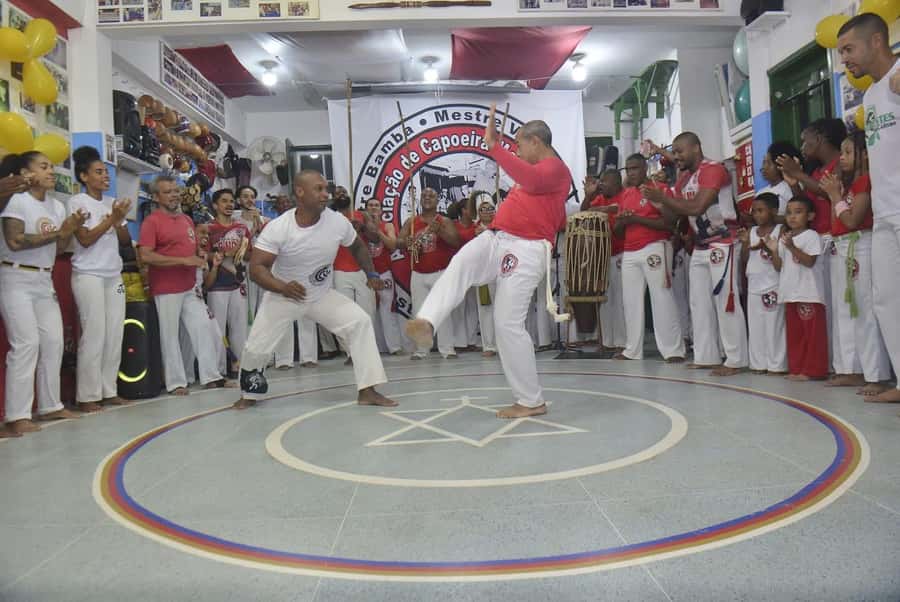
The evening begins with Capoeira, the part most closely tied to Mestre Bimba’s legacy. A roda brings participants into a circle, where they respond to the rhythm and to one another with quick, controlled movements.
You can expect fast and intense exchanges rather than a simple dance demonstration. The performance includes acrobatics, but the point is not only to show off difficult moves. The music, singing, footwork, timing, and interaction give the roda its character.
One appealing feature is the range of people involved. The performance can include different ages and genders, which helps you see Capoeira as a living practice rather than a specialty reserved for professional performers. That variety also makes the evening feel connected to the association itself.
The tradeoff is that the action may not look perfectly uniform. This is not presented as a tightly scripted theater routine. Some exchanges may be more exciting than others, and the quality can vary from one section to the next. I consider that a fair exchange for seeing a less polished and more personal form of Capoeira.
If you want a flawless acrobatic production with every beat timed to the second, this may not be the right choice. If you want to see the energy of a real Capoeira gathering, the looseness is part of the appeal.
Samba brings the room to life
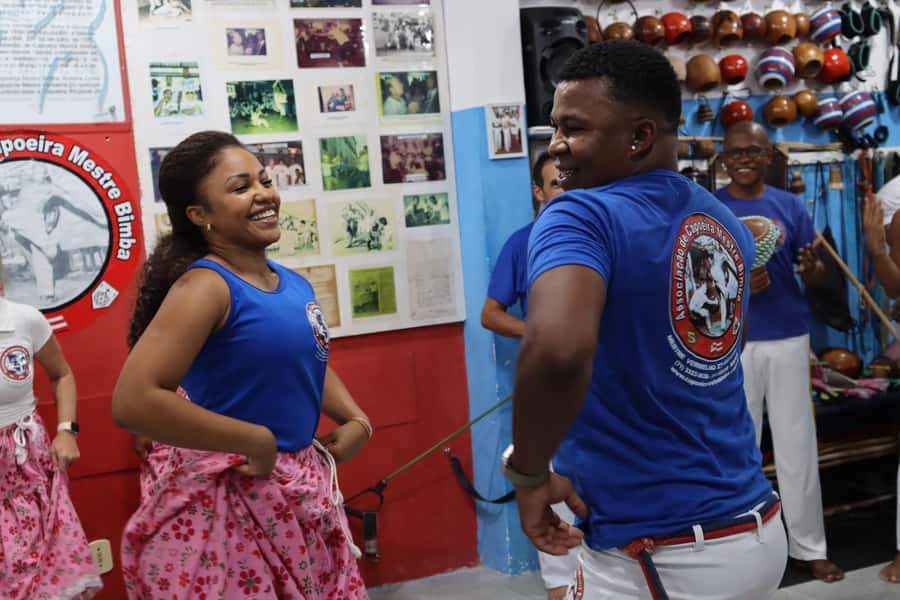
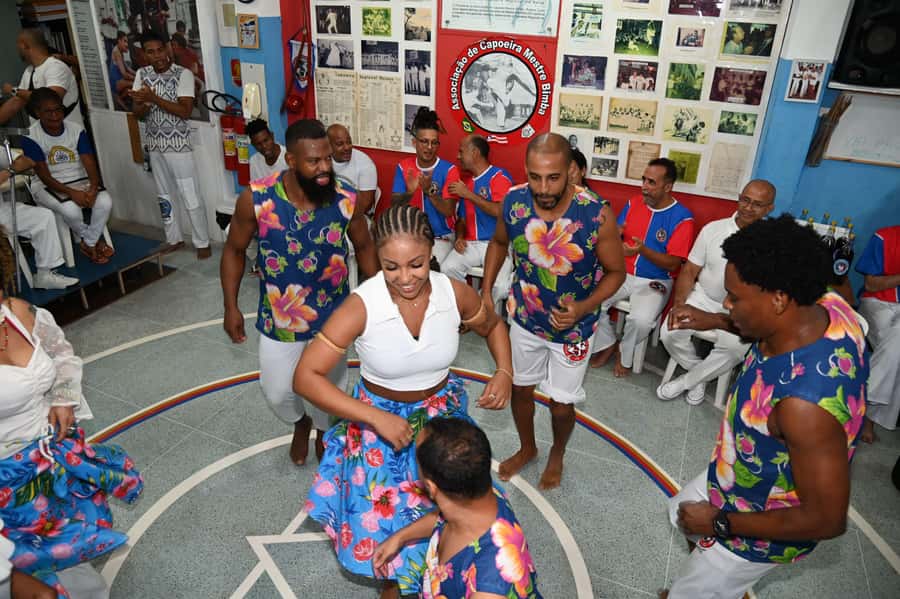
After the Capoeira sections, Samba adds a lighter and more dance-centered mood. Live music and singing support the movement, so you experience Samba as a social art rather than a short dance inserted between unrelated acts.
The program gives men and women space to perform, and the music helps the room shift from focused martial movement to celebration. You may find the Samba portion less formal than a professional stage show, but that is consistent with the evening’s purpose.
I like this part because it helps you understand the relationship between rhythm and movement in Brazilian culture. Instead of hearing a guide describe Samba from a distance, you see how the beat directs the room.
The heat matters here. The space can become warm as the program continues, especially with movement, singing, and a full audience. Bring water for before or after the performance, since food and drinks are not included. A refreshing treat may be offered at the end, but you should not count on a meal or a full beverage service.
A few more trips worth weighing up before you book
- Salvador by Night: Cultural Dinner and Show
★ 4.7 · 27 reviews - Salvador by Night: Cultural Show and Dinner.
★ 4.4 · 17 reviews - Salvador by Night: Pelourinho & Old Town Tour
★ 4.3 · 8 reviews - Rio de Janeiro: Sunset Sailing Tour
★ 4.8 · 994 reviews
Maculelê and the power of percussion
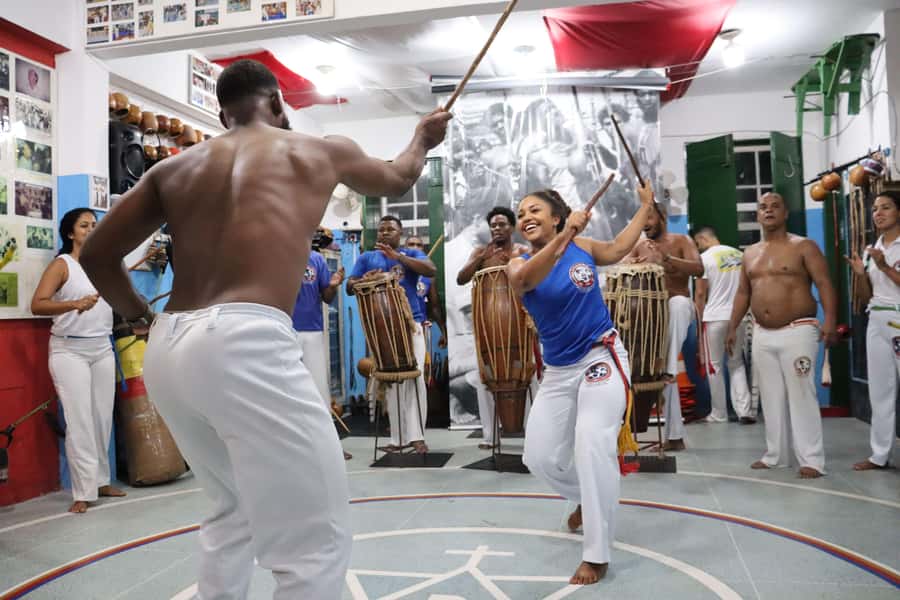
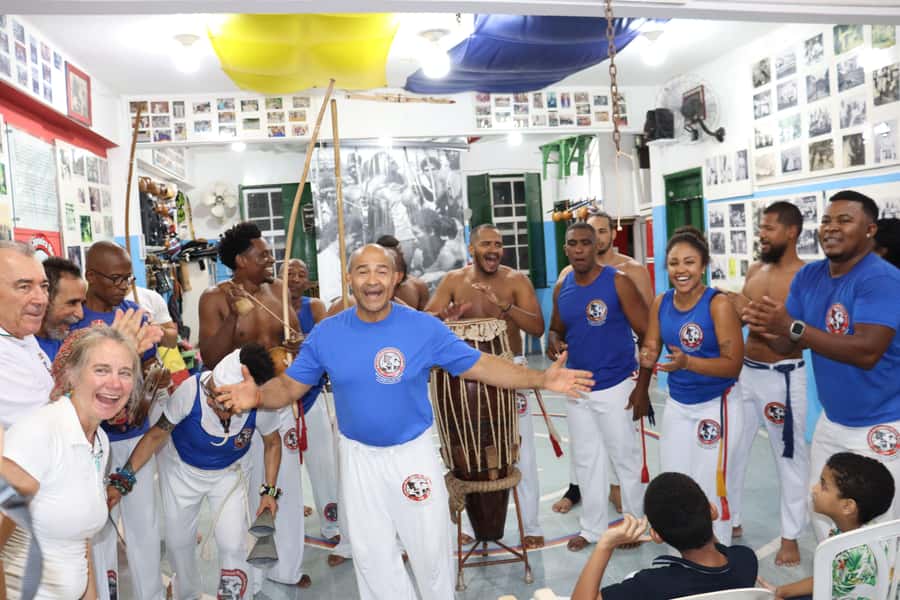
Maculelê gives the night another physical style. It is presented with fiery movement and acrobatics, backed by traditional drumming and live music. The result is more theatrical than the Capoeira roda, but it still belongs to the same musical world.
This section is useful because it keeps the program from becoming repetitive. You see how Brazilian performance can shift between combat-like motion, dance, group rhythm, and acrobatic display. The drummers are not background decoration. Their pulse helps set the speed and mood of the action.
The traditional drumming is one of the evening’s most praised elements. It gives the show its strongest sense of momentum, especially when joined by singing. You may notice that the musicians and performers seem to feed off one another, rather than following a detached soundtrack.
As with Capoeira, the standard is not perfectly even from one moment to the next. Some sections may feel more powerful than others. That is worth knowing before you book, particularly if you are comparing this with a large-scale theater production. Here, the appeal comes from participation, energy, and cultural setting.
A performance that does not pretend to be polished
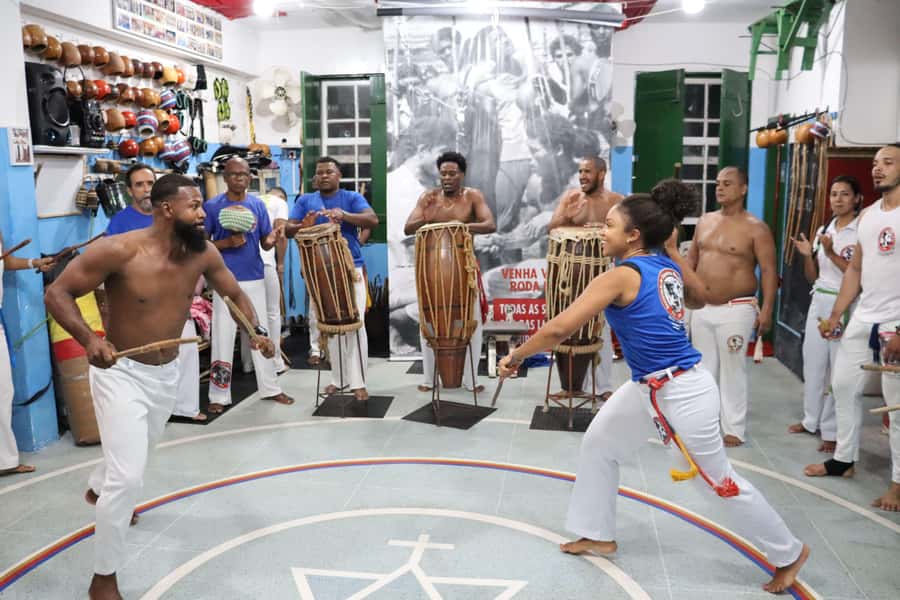
The organizers make a clear distinction between this evening and a tourist show built around fixed routines. The experience is presented as an organic celebration, with spontaneous movement and real association members taking part.
That can be a major advantage. You get a stronger sense of how Capoeira, Samba, and drumming are practiced by people, not just packaged for an audience. The show also allows you to see a range of skill levels and personalities.
It can also require a little patience. One booking described the event as training by members of an association, with performances that were real but uneven. That is probably the fairest way to set your expectations. You are paying for access to a cultural setting and a lively presentation, not for a precision dance company.
I would compare it to watching a respected local music group in its own community space. The best moments can feel immediate and exciting because they are not overcontrolled. The weaker moments remind you that this is a living practice, not a machine-made product.
How much time should you allow?
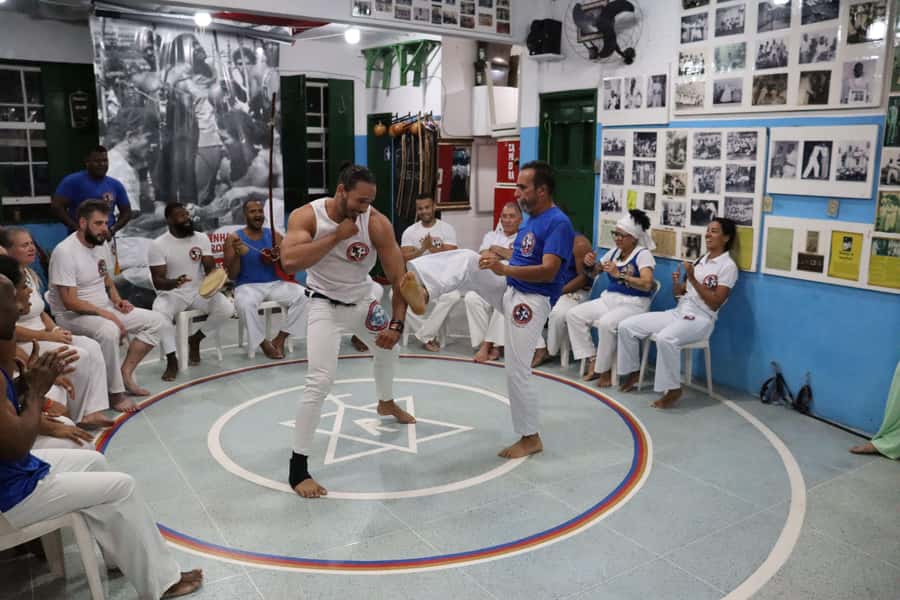
The advertised duration is one hour, while the detailed itinerary describes the concert and dance presentation as lasting about one and a half hours. Because of that discrepancy, check the available start time and expected length when booking.
Even at the shorter duration, the program covers a lot: Capoeira, Samba, Maculelê, drumming, live music, and acrobatics. You get a compact introduction rather than an entire evening of instruction or historical presentation.
The short format can work well in Salvador. You can fit it into a night that also includes dinner or a walk through the old center. It is not a good substitute for a full Capoeira class, since the experience is designed for watching rather than hands-on training.
The fast pace may also be helpful if you are traveling with children or with companions who do not want a long formal performance. At the same time, a one-hour show leaves little room for explanation. Most of what you learn comes through rhythm and action.
Is $30 a fair price?
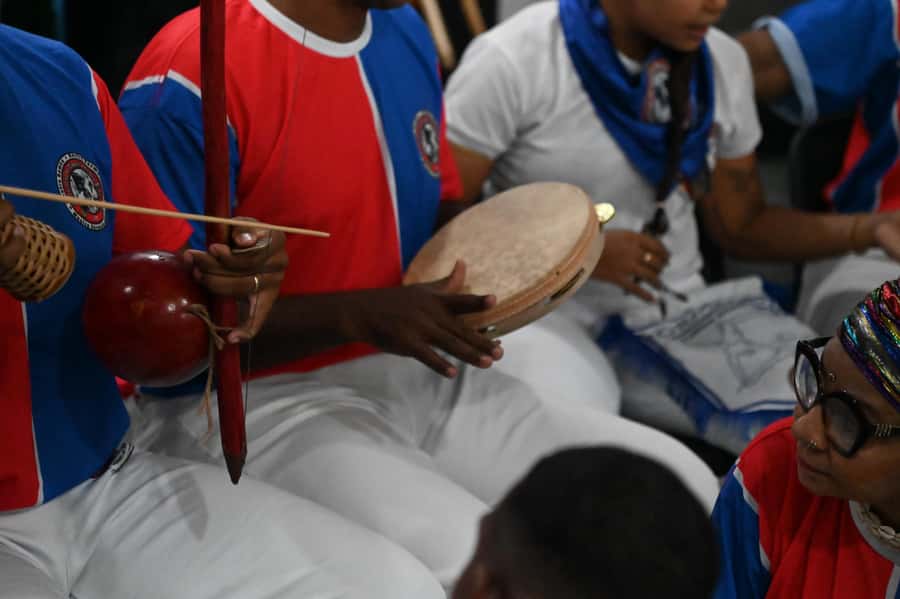
At $30 per person, I consider this a fair price for the setting and variety. You are not paying only for a seat. The ticket gives you entry to a respected Capoeira school associated with Mestre Bimba, plus several forms of music and movement in one visit.
The value is strongest if you want cultural context without committing to a long tour. In one compact program, you see Capoeira, Samba, Maculelê, traditional drumming, live music, and acrobatics. A private lesson or separate performances could cost more and require extra planning.
The price is less attractive if you expect a large production, elaborate costumes, a meal, or transportation. None of those are included. You should also factor in the cost of reaching the venue and buying your own refreshments.
For me, the historic school is what makes the ticket worthwhile. A similar show in an anonymous venue would need to be cheaper to offer the same value. The setting adds meaning that cannot be measured only in minutes of entertainment.
Who will enjoy this evening most?
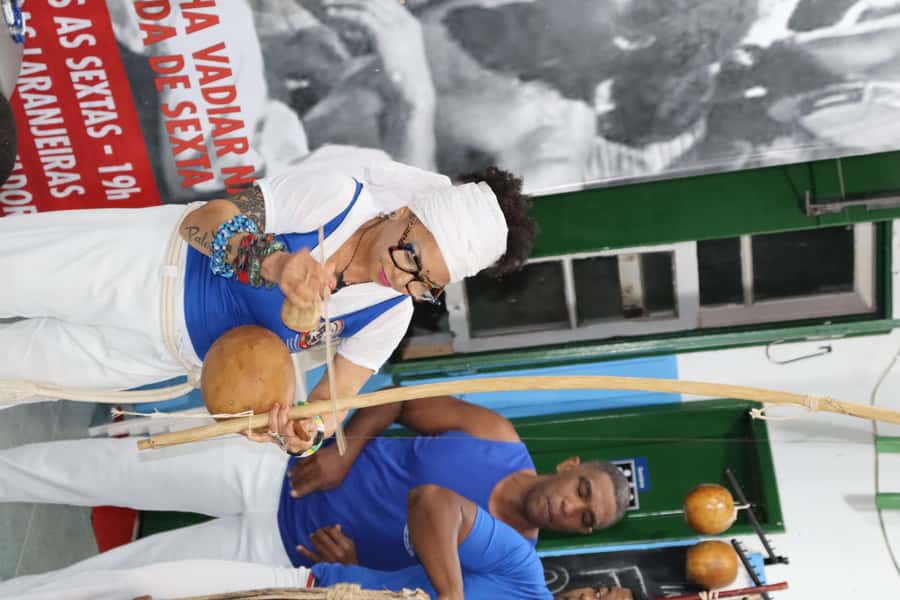
This experience suits you if you want to connect with Salvador through music and movement. It is especially good for first-time visitors who want a direct introduction to Afro-Brazilian culture without spending an entire day in a classroom or museum.
It also fits people who prefer informal performances to polished productions. You can expect passion, participation, and spontaneous moments. You should be comfortable with some variation in performance quality.
The event may not suit you if you have back problems or are pregnant, since the program includes fast movement and acrobatics. It is also not ideal if you dislike heat or want a quiet, seated concert.
Wear comfortable shoes and clothes. Smoking is not allowed. English and Portuguese are available, which can help if you want some guidance around the presentation, though the performance itself communicates much through sound and movement.
Practical expectations from start to finish
You meet at Associação de Capoeira Mestre Bimba, using Ó Paí Ó Restaurante or São Domingos Gusmão Church as nearby reference points in Largo do Terreiro de Jesus. Since no pickup is provided, allow time to reach the venue and confirm the entrance.
The program opens with Capoeira and moves through Samba, Maculelê, drumming, singing, music, and acrobatics. You will see quick exchanges in the rodas, group movement, and a range of participants rather than one uninterrupted routine by a single cast.
The room may grow hot, so keep your clothing simple and breathable. Bring water for your own use, since food and drinks are not part of the ticket. A small refreshing treat may be offered afterward, but it should be viewed as an extra courtesy rather than a promised meal.
You can cancel up to 24 hours before the experience for a full refund, and the reserve-now, pay-later option keeps your plans flexible. Those policies are useful if your Salvador schedule is still changing.
Should you book the Capoeira cultural night?
I would book this for the setting, the cultural value, and the range of performance styles. The link to Mestre Bimba’s 1937 school gives the evening a sense of place that a generic Samba show cannot match.
Go in expecting an energetic association presentation, not a flawless theater production. You may see uneven sections, but you will also see real movement, strong drumming, singing, and the participation of people across ages and genders.
At $30, it is a good pick for an accessible introduction to Salvador’s Capoeira and Afro-Brazilian performance traditions. Skip it only if you need air-conditioned comfort, guaranteed stage precision, or a fully catered night out.
FAQ
Where does the cultural night take place?
It takes place at Associação de Capoeira Mestre Bimba in Salvador, near Largo do Terreiro de Jesus.
How long does the experience last?
The activity is advertised as one hour, while the detailed presentation is listed as about one and a half hours. Check the available time and expected duration when booking.
What performances are included?
The program includes Capoeira, Samba, Maculelê, traditional drumming, live music, and acrobatics.
Is transportation to the venue included?
No. You must make your own way to Associação de Capoeira Mestre Bimba, since pickup service is not offered.
Are food and drinks included?
No. Food and drinks are not included in the ticket. A refreshing treat may be offered afterward, but this is not listed as a meal or beverage service.
Is the experience available in English?
Yes. Live tour guidance is available in English and Portuguese.
Just added around Salvador
- From Salvador: Schooner Tour to Frades Island★ 3.9 · 3 reviews
- From Salvador: Quilombo Heritage Daytrip with Lunch★ 3.4 · 3 reviews
- Salvador: Caipirinha Masterclass with Unlimited Drinks★ 4.2 · 4 reviews
- Salvador: Schooner Cruise with Pickup and Itaparica Stop★ 3.8 · 5 reviews
- BOXE CLASS – EX BAHIAN CHAMPION (SALVADOR-BA)★ 5.0 · 7 reviews
- Salvador by Night: Pelourinho & Old Town Tour★ 4.3 · 8 reviews
- Salvador: Traditional Drumming and Percussion Workshop★ 4.4 · 10 reviews
- Salvador: 3-Hour Percussion Class★ 4.9 · 10 reviews
Samba & Nightlife Tours, compared.
Pub Crawl in Lapa with Cachaça Tasting and Live Samba
Read our review →
Carnival Backstage Tour at Samba City with Cocktail
Read our review →
Hop-ON Hop-OFF Sightseeing Bus in Rio de Janeiro – Rio Samba Bus
Read our review →
Santa Teresa, Lapa, and Cinelândia with Tram Ride and Selarón Steps
Read our review →
Ginga Tropical – Brazilian Samba and Folklore Show
Read our review →Browse the lists this tour appears in