Reviewed · SANTA TERESA & SELARON STEPS TOURS
Centro Historico and Lapa – Santa Teresa Walking, Historical and Bohemian Tour
Rio’s old center rewards a slow, curious walk. This full-day tour links Centro Histórico, Santa Teresa, and Lapa through churches, public squares, street art, and a ride on the famous yellow tram. I like the careful mix of major sights and smaller street scenes, and I like that guide Ivan brings Rio’s past to life with clear storytelling. The main drawback is the pace: seven to eight hours on foot can feel long, especially in warm weather.
The route also gives you several views that are hard to arrange on your own, from the churches near Largo da Carioca to Parque das Ruínas and Mauá Square. Lunch is not included, and the tour is non-refundable, so you should be sure of your plans before booking.
In This Review
- Key things to know before booking
- Why this Rio walking tour works
- Cinelândia and the grand face of central Rio
- The Metropolitan Cathedral and two remarkable churches
- Confeitaria Colombo and the old pedestrian streets
- Praça Quinze and the waterfront story
- Praça Pio X and the Candelária church
- São Bento monastery and Mauá Square
- The Etnias mural and Rio’s Olympic-era public art
- Riding the yellow Bonde to Santa Teresa
- Santa Teresa’s old houses and Largo dos Guimarães
- Parque das Ruínas and the best viewpoints
- Selarón Steps and the descent to Lapa
- Timing, price, and what you receive
- Who should book this experience?
- Should you book the Centro Histórico, Santa Teresa, and Lapa tour?
- FAQ
- Where does the tour start?
- Where does the tour end?
- How long does the tour last?
- How many people can join the tour?
- Is lunch included?
- Is the Santa Teresa tram ride included?
- Can the booking be canceled or changed?
Key things to know before booking
- Three Rio districts in one day: You move from the grand civic buildings of Centro to the old streets of Santa Teresa and the nightlife district of Lapa.
- A rare tram ride: The 30-minute Bonde journey up to Santa Teresa is one of the tour’s most memorable sections.
- Fourteen substantial stops: The route includes churches, cultural buildings, squares, murals, viewpoints, and historic transport.
- Small group size: The maximum is 12 people, a useful limit for a long walking day.
- A drink is included: You receive a caipirinha, beer, soda, fruit juice, or water during the tour.
- Strong guide praise: Ivan, also written as Yvan in one French-language comment, is singled out for his storytelling and knowledge of Rio.
Why this Rio walking tour works
This is not a quick photo stop tour. It is a long, connected route through the parts of Rio that often get less attention than Copacabana and Ipanema. You begin at 9:00 a.m. outside the Copacabana Palace, then spend the day walking, looking up, entering churches, riding the tram, and finishing beneath the Arcos da Lapa.
I like the way the route builds a picture of Rio in layers. You see government buildings, religious art, colonial-era streets, public art from the Olympic period, and neighborhoods that still feel tied to earlier Rio. The guide’s role matters here. At several stops, the buildings themselves are impressive, but the story behind them is what makes the visit worth your time.
The tour is capped at 12 people. That is small enough to make questions practical without promising a private tour. The day lasts about seven to eight hours, so you should expect a serious outing rather than a gentle morning stroll.
More Historical Tours in Rio de Janeiro
- Rio de Janeiro: Historic Rio and Santa Teresa Half-Day Tour
★ 4.4 · 228 reviews - Rio de Janeiro: Little Africa Heritage Walking Tour
★ 4.9 · 177 reviews - Explore Little Africa : Unveiling Afro Heritage in Rio de Janeiro
★ 5.0 · 97 reviews
Cinelândia and the grand face of central Rio
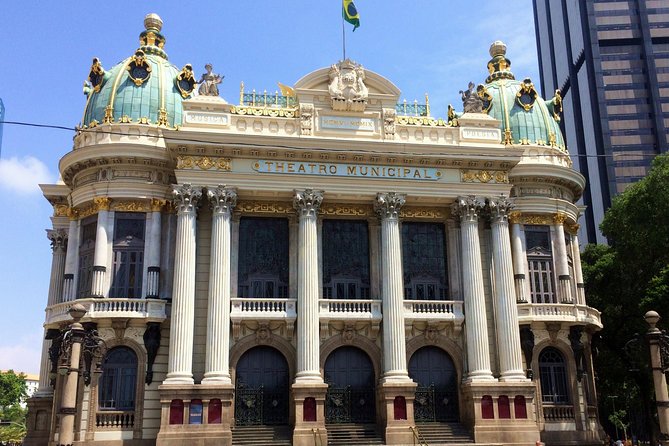
The first stop is Cinelândia, one of the city center’s most important public squares. You get about 20 minutes to see the Teatro Municipal, Rio’s opera house, along with the Museu das Belas Artes, the municipal chamber, the Biblioteca Nacional, and the Odeon cinema.
This is a good opening because the square gathers several major institutions in one place. The Teatro Municipal gives the area a formal, European feel, while the library and fine arts museum show Rio’s role as Brazil’s cultural capital. The Odeon is especially interesting because it is the only cinema in the square still operating.
You do not receive an admission visit to these buildings during the stop. The value is in the guide’s presentation and in seeing how the square fits together. If you want to visit the interiors of the museums or theater, you would need separate time and tickets outside this tour.
The Metropolitan Cathedral and two remarkable churches
The Metropolitan Cathedral of Saint Sebastian follows Cinelândia. The visit lasts about 15 minutes and includes the inside of the cathedral, its unusual architecture, its story, and its huge stained-glass windows.
The cathedral is a sharp change from the older churches later in the day. Its modern form and tall colored windows give you a different view of Rio’s religious architecture. Fifteen minutes is enough for an introduction and a look around, but not for a long quiet visit.
At Largo da Carioca, the tour turns to the Church of São Antônio and the Church of São Francisco da Penitência. You spend about 25 minutes here, with admission included. The two churches sit beside each other, and the terrace offers a broad view over the city center.
The Church of São Francisco da Penitência is presented as one of Brazil’s finest baroque churches. That is a strong claim, but this is one of the tour’s most worthwhile interior visits. The combination of carved decoration, religious art, and the elevated view gives this stop more weight than a simple exterior photograph.
Confeitaria Colombo and the old pedestrian streets
The walk continues through pedestrian streets toward Confeitaria Colombo. You have about 10 minutes at this famous café, one of Rio’s oldest, known for its Art Deco style.
Ten minutes is brief, so do not expect a full café meal or a leisurely pastry break as part of the scheduled visit. Instead, you get an introduction to a landmark of central Rio and a chance to see how the old streets connect one attraction to the next.
I like this section because it adds everyday urban texture between the grand churches and squares. The route is not built only around monuments. You also see the old street pattern and the kind of café that has become part of Rio’s public identity.
More Walking Tours in Rio de Janeiro
- Rio de Janeiro: Rocinha Favela Walking Tour with Local Guide
★ 4.8 · 3,052 reviews - Rio De Janeiro: Half-Day Rocinha Favela Walking Tour
★ 4.7 · 2,272 reviews - Sunrise and Sunrise Walk Two Brothers with Local Guide
★ 5.0 · 193 reviews - Learn the History of Rio with an Unforgettable City Center Walking Tour
★ 5.0 · 82 reviews
Praça Quinze and the waterfront story
At Praça Quinze de Novembro, the guide explains several sites over roughly 20 minutes. You see the Church of Our Lady of Carmel, the Paço Imperial, the equestrian statue of General Osório, Ilha Fiscal, and the ferry pier serving Niterói and Paquetá Island in Guanabara Bay.
This stop brings politics, monarchy, public ceremony, and water transport into the same view. The square’s name refers to November 15, the date associated with the proclamation of Brazil’s republic. The Paço Imperial adds an important royal connection, while the ferry pier reminds you that central Rio is still tied to the bay.
The stop is primarily an outdoor presentation. That means you get useful context without spending much time inside each building. If you are keen to visit the imperial palace or explore the islands, you would need a separate plan.
Praça Pio X and the Candelária church
Next comes Praça Pio X, reached by pedestrian streets. The 15-minute stop includes the Candelária church, the Olympic Boulevard, Centro Cultural Banco do Brasil, and Casa França-Brasil.
Candelária is one of the city center’s best-known churches, and its position near major cultural centers shows how much is packed into this part of Rio. The Olympic Boulevard adds a newer layer, while the cultural buildings point to the area’s continuing role in exhibitions and public events.
The tour does not list interior visits to the cultural centers. You should think of this section as a guided orientation. It helps you decide where you might want to return if you have another afternoon in Rio.
São Bento monastery and Mauá Square
The Monastery of São Bento is one of the day’s key church visits. You spend about 15 minutes inside while the guide explains its story and points out its design.
The monastery is widely regarded as one of Rio’s finest churches, and it provides another strong contrast with the Metropolitan Cathedral. The short visit works well if you want to see several places in one day, though anyone fascinated by church interiors may wish for more time.
The route then reaches Mauá Square for about 20 minutes. This is a major cultural area, with the Museum of Tomorrow and the Museu de Arte do Rio. The tour does not enter the Museum of Tomorrow, but its architecture is part of the presentation. The art museum’s upper terrace offers views toward Mauá Square, the Niterói Bridge, and the Museum of Tomorrow.
This is one place where the tour gives you useful orientation rather than a full museum visit. You can see how the waterfront has been reshaped as a cultural district, then note which museum you might return to later. The terrace view is a practical bonus if access is available during the visit.
The Etnias mural and Rio’s Olympic-era public art
The Etnias mural is credited to Eduardo Kobra and was created for the Olympic Games. It represents five ethnic groups and is considered the largest mural in the world.
You get about 15 minutes here. That is enough to take in the scale and hear why the work was made, though the size of the mural makes it difficult to absorb every section in a short stop.
This is a useful counterpoint to the churches and imperial buildings. The tour shows Rio not only as an old colonial and royal city, but also as a place that uses large public art to present a modern civic identity. The mural works best as part of the wider route, rather than as a stand-alone attraction.
Riding the yellow Bonde to Santa Teresa
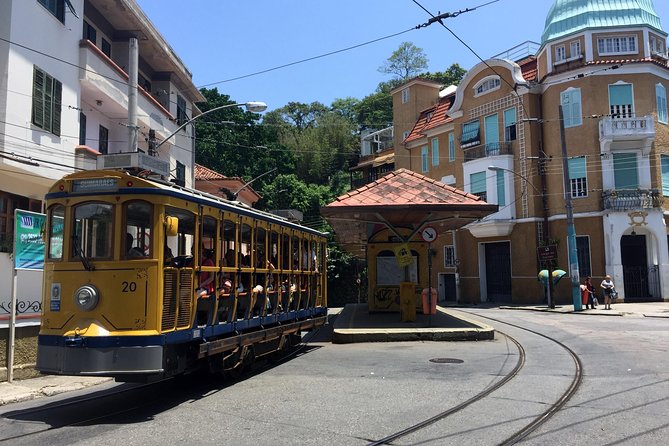
From the mural, you return to the Santa Teresa tram station and board the yellow Bonde. The ride takes about 30 minutes and is listed as an included part of the tour, with about 45 minutes allowed for the whole station and tram section.
This is the day’s signature transport experience. The tram carries you uphill toward Santa Teresa, giving you a moving view of the city and a change of pace after hours of walking. I like that the tour uses public transport as part of the story instead of treating the city as a series of disconnected stops.
The tram ride is also one reason to book this tour instead of arranging a standard center-city walk. It connects the lower city to Santa Teresa in a way that feels tied to Rio’s character. Since the group travels together, the guide can keep the ride connected to the rest of the day.
Santa Teresa’s old houses and Largo dos Guimarães
Once in Santa Teresa, the tour spends about 45 minutes around Largo dos Guimarães. You see houses dating from the late 19th and early 20th centuries, along with views, restaurants, and bars.
This is the most relaxed section of the route. Santa Teresa has a different mood from the formal center, with older residential buildings and a neighborhood setting that has made it popular for dining and nightlife. You get time to look around rather than simply stop for a single building.
The long walking day matters here. By this stage, you may appreciate the chance to slow down, but the hills and earlier walking can make the same 45 minutes feel demanding. Wear comfortable shoes and treat the day as an active outing.
Parque das Ruínas and the best viewpoints
The Centro Cultural Municipal Parque das Ruínas is described as Santa Teresa’s iconic point. It was once the home of Laurinda Santos Lobo and is now a lookout with views toward central Rio, the Arcos da Lapa, Christ the Redeemer, and Botafogo.
This is one of the strongest photo stops on the tour. You see several parts of Rio from one elevated position, and the setting adds an old-house atmosphere to the view. The stop lasts about 30 minutes, enough for the guide’s explanation and time to look outward.
The value here is visual and geographic. After hearing about the city’s churches, squares, and waterfront, you can finally place many of those areas in relation to one another. Clear conditions will affect how much you see, but the stop is still important even when the distant views are less sharp.
Selarón Steps and the descent to Lapa
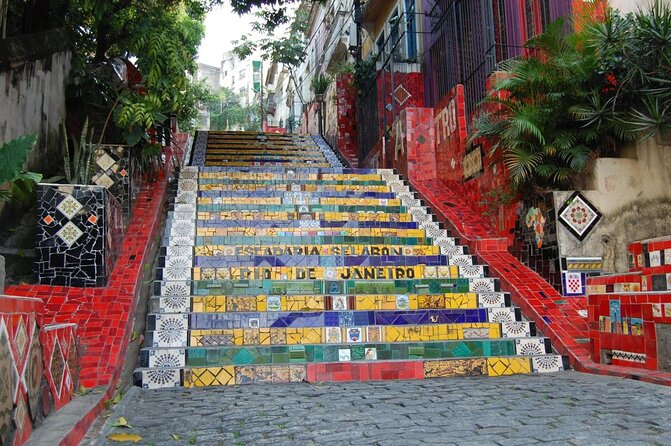
The tour leaves Santa Teresa and heads downhill toward Lapa, stopping for about 30 minutes at the Escadaria Selarón. The staircase was created over roughly 20 years by Chilean artist Jorge Selarón.
The colored tiles make this an easy place to enjoy without a long explanation, but the artist’s sustained work gives it more meaning than a quick street-art backdrop. You get time to look at the details and photograph the stairs.
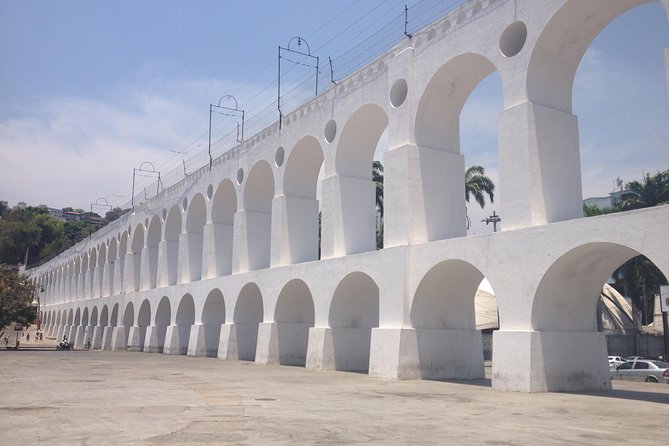
The route then continues past more graffiti to the Arcos da Lapa. The arches are an old Rio aqueduct from the 18th century that supplied the city with water until the end of the 19th century. The Santa Teresa tram crosses the aqueduct on its route uphill.
This final section neatly connects the day’s subjects: engineering, public transport, street art, and neighborhood life. The arches are also a strong ending because they are both a historic structure and a working visual symbol of Lapa.
Timing, price, and what you receive
The listed price is $137.80 per person. That is a significant cost for a walking tour, but the tour covers seven to eight hours, has a maximum of 12 people, includes the Santa Teresa tram, includes entry to the two churches near Largo da Carioca, and provides one drink.
The value depends on how you would otherwise organize the day. If you would pay separately for transport, arrange a guide, research the churches, and work out the route between Centro, Mauá Square, Santa Teresa, and Lapa, the price becomes easier to justify. If you mainly want a short introduction to the center, it is more than you need.
Lunch is not included. Plan for that gap, since the tour spans most of the day. The description does not specify a restaurant or a fixed lunch break, so you should confirm how the guide handles the meal before departure.
The booking pattern suggests reserving ahead, with the tour averaging about 18 days of advance booking. Confirmation is provided at booking, and the experience requires a minimum number of people. If that minimum is not reached, you are offered another date or experience, or a full refund.
The cancellation terms are strict: the booking is non-refundable and cannot be changed for any reason. That makes travel insurance or firm scheduling especially useful for this particular activity.
Who should book this experience?
I would choose this tour if you want a serious introduction to Rio’s central districts and prefer a guide to connect the facts. It suits anyone interested in architecture, churches, public art, city history, old neighborhoods, and local transport.
It is also a good choice if you have limited time in Rio but want more than the beaches and famous viewpoints. In one day, you cover a broad section of the city and get enough context to return to a museum, church, or neighborhood on your own.
I would hesitate if you dislike long walks, hills, warm-weather sightseeing, or a full schedule. The itinerary has 14 stops, and several are short. You see a lot, but you do not get extended free time at most attractions.
The guide can make a real difference. The strongest praise in the available feedback is for Ivan, who is described as knowing Rio and its past very well and as being an excellent storyteller. That is exactly the skill this route needs, since many stops are introductions rather than full admissions.
Should you book the Centro Histórico, Santa Teresa, and Lapa tour?
Book it if you want one well-packed day of Rio’s older center, hilltop Santa Teresa, and Lapa, with churches, viewpoints, murals, and the yellow tram all included. The small group and strong praise for Ivan add confidence, while the broad route gives you a useful first look at parts of Rio that many short city tours skip.
Skip it if you want a slow museum day, a long lunch, or flexible time at each sight. At $137.80, it makes the most sense for an active visitor who values a guide’s storytelling and wants the city connected into one clear route.
FAQ
Where does the tour start?
It starts at 9:00 a.m. at the Copacabana Palace, A Belmond Hotel, at Av. Atlântica, 1702, Copacabana, Rio de Janeiro.
Where does the tour end?
The activity ends back at the meeting point.
How long does the tour last?
The tour lasts approximately seven to eight hours.
How many people can join the tour?
The group has a maximum of 12 people.
Is lunch included?
No. Lunch is not included in the tour price.
Is the Santa Teresa tram ride included?
Yes. The tram section is listed as included, with about 45 minutes allowed for the station and panoramic ride.
Can the booking be canceled or changed?
No. The experience is non-refundable and cannot be changed for any reason. If the provider cancels because the minimum number of people is not met, you can receive a full refund or choose another date or experience.
More Samba and Nightlife Tours
- Rio de Janeiro: Beginner Samba Lesson in Ipanema
★ 4.9 · 1,071 reviews - Rio: Pub Crawl in Lapa with Cachaça Tasting and Live Samba
★ 4.7 · 881 reviews - Rio: Carnival Backstage Tour at Samba City with Cocktail
★ 4.6 · 520 reviews - Hop-ON Hop-OFF Sightseeing Bus in Rio de Janeiro – Rio Samba Bus
★ 3.5 · 457 reviews
More Santa Teresa and Selaron Steps Tours
- Rio: Christ the Redeemer, Sugarloaf, Selaron & BBQ Lunch
★ 4.5 · 2,428 reviews - Rio de Janeiro: Christ, Selaron Steps, and Tijuca Park Tour
★ 4.7 · 857 reviews - Santa Teresa, Lapa, and Cinelândia with Tram Ride and Selarón Steps
★ 4.5 · 274 reviews - Corcovado, Sugarloaf Mountain, and Selarón Steps 6-Hour Tour
★ 4.3 · 167 reviews
Just added around Rio de Janeiro
- Pedra Bonita Trail: The easiest trail with a beautiful view of Rio★ 4.6 · 3 reviews
- Rio: Private, Custom express, Main Attractions!★ 5.0 · 3 reviews
- Rocinha Jeep Tour: A Journey into the Soul of the Favela!★ 3.8 · 3 reviews
- Rio: Favela Walking Tour of Rocinha with a Resident Guide★ 4.7 · 3 reviews
- Rio: Museum of Tomorrow, Yup Star & Olympic Boulevard★ 3.7 · 3 reviews
- Explore Fernando de Noronha: 7-Hour Ilhatour★ 4.9 · 3 reviews
- Rio: Best Dive Experience All Inclusive Scuba Diving Package★ 5.0 · 3 reviews
- Rio de Janeiro by Air: 10-Minute Helicopter Tour★ 4.4 · 3 reviews
Santa Teresa & Selaron Steps Tours, compared.

Christ the Redeemer, Sugarloaf, Selaron & BBQ Lunch
Read our review →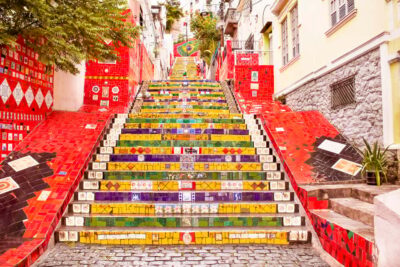
Santa Teresa, Lapa, and Cinelândia with Tram Ride and Selarón Steps
Read our review →

Corcovado, Sugarloaf Mountain, and Selarón Steps 6-Hour Tour
Read our review →
Ancient Rio and Santa Teresa Tour with Hotel pick-up and drop-off
Read our review →
Christ the Redeemer & Selarón Steps Half-Day Tour
Read our review →