
Reviewed · FAVELA TOURS
Rio de Janeiro: Favela Santa Marta Tour with Resident Guide
Meet Rio beyond the postcards. This Santa Marta tour offers a resident-led look at daily life, guided by Gilson Fumaça, who was born and raised in the community and has worked on local projects for decades. I like the personal scale of the experience and the way it connects history, family, music, education, and community life. The main drawback is the steep walking, with many stairs and heat that can make the route tiring.
I also like that this is not only a sightseeing walk. You may visit Gilson’s family home, see his mother Maria Helena’s collection of more than 400 clocks, meet local people, and learn about education, language, art, and environmental projects. Comfortable shoes and moderate fitness matter, especially if you visit during hot weather.
In This Review
- Key points to know before booking
- Why Santa Marta is best seen with a resident guide
- Starting in Botafogo and entering Santa Marta
- The cable car and the climb through Santa Marta
- Santa Marta’s viewpoints: Christ the Redeemer and Sugarloaf
- The family home and the famous clock collection
- Daily life, local projects, and community work
- Local food, shopping, and Michael Jackson Square
- Safety, comfort, and the right attitude
- Is $27 good value?
- Who should book the Santa Marta tour?
- Should you book it?
- FAQ
- Where does the Santa Marta tour meet?
- How long does the tour last?
- Which languages are available?
- Is a local guide included?
- Is bottled water included?
- Is the cable car ride part of the experience?
- Will I see the Michael Jackson filming location?
- Is the tour suitable for wheelchair users?
- Can I cancel and receive a refund?
Key points to know before booking
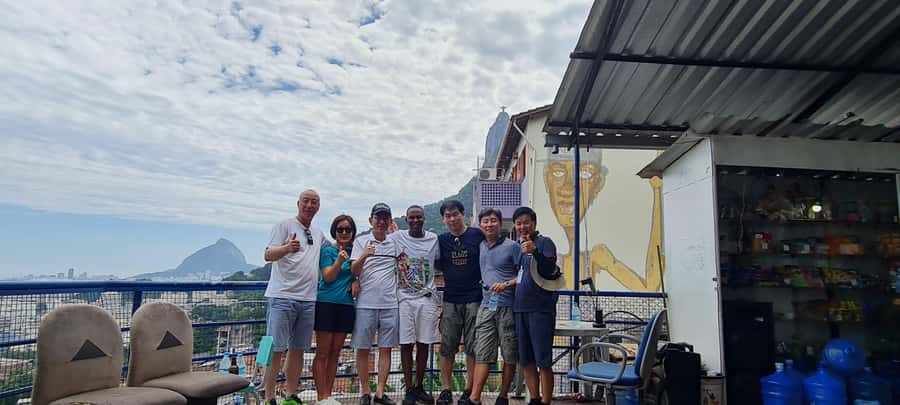
- Gilson Fumaça leads from personal experience: He was born and raised in Santa Marta and is a recognized community leader and licensed tourism guide.
- The tour has a social purpose: Your visit helps support educational, cultural, and environmental work connected to the favela.
- Michael Jackson history is part of the route: Santa Marta featured in the 1996 video for They Don’t Care About Us, and Gilson was present during the production.
- You see more than viewpoints: The route can include a family home, local projects, a restaurant, a football court, and the famous Michael Jackson Square.
- The views are excellent: From higher points, you can look toward Christ the Redeemer and Sugarloaf Mountain.
- The walk is physically demanding: The experience is not suitable for wheelchair users or people with mobility impairments.
Why Santa Marta is best seen with a resident guide
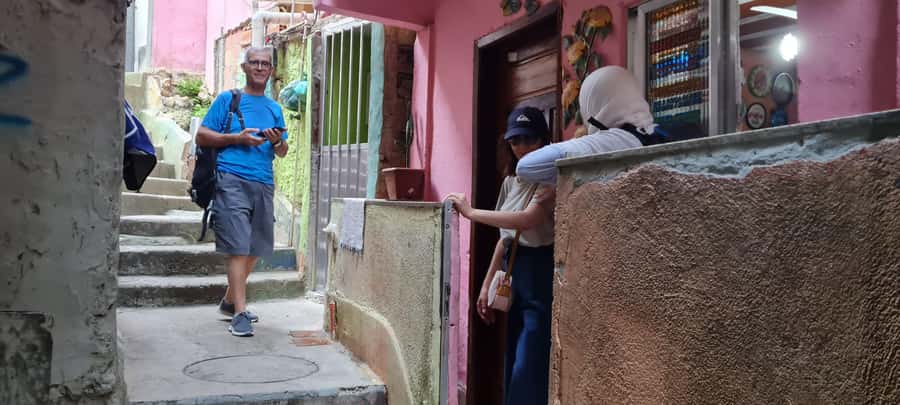
A favela is not a museum or a staged attraction. It is a living neighborhood, and that makes the choice of guide important.
Gilson Fumaça has spent his life in Santa Marta. The description of his work presents him as a community leader first and a guide second. That distinction matters. He knows the streets, the residents, the local challenges, and the projects trying to create better options for children and young people.
His background also gives the tour unusual links to Rio’s popular culture. He was involved around the filming of Michael Jackson’s They Don’t Care About Us in 1996. He has also worked with visiting public figures and music productions, including projects connected with Joe Biden, Cara Delevingne, Seu Jorge, Tito Jackson, and Italian rappers.
You are not simply shown a wall from a music video and sent on your way. The route uses those famous moments as a doorway into a larger story about Santa Marta. You learn how outside attention can bring recognition, but also how it can reduce a neighborhood to a single image.
The guide’s local connections are another major benefit. Gilson knows many people in the community, and that changes the tone of the walk. Several parts of the experience may feel more like being introduced around someone’s home than being led through an anonymous attraction.
More guided community visits:
- Rio de Janeiro: Rocinha Favela Walking Tour with Local Guide
★ 4.8 · 3,052 reviews - Rio De Janeiro: Half-Day Rocinha Favela Walking Tour
★ 4.7 · 2,272 reviews - Rio de Janeiro: Favela Santa Marta Top Tour with Local Guide
★ 4.9 · 488 reviews
Starting in Botafogo and entering Santa Marta
The meeting point is listed at R. São Clemente, 320, near the tourist information point, although the exact meeting location can depend on the option you book.
From there, the group reaches Favela Santa Marta for an introduction, guided walk, and short safety briefing. The safety talk is useful because it gives you the basic ground rules for moving through a residential community. You are visiting people’s homes and streets, not walking through a theme park.
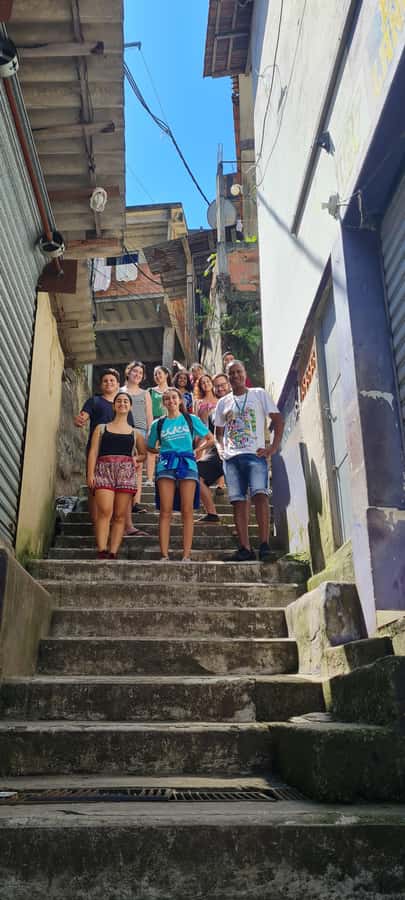
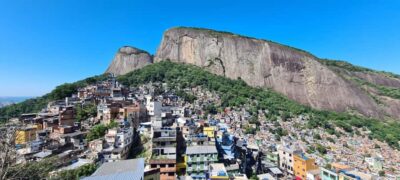
The early part of the route helps you get your bearings. Santa Marta rises up the hillside, so the walk quickly becomes a mix of narrow lanes, stairs, painted walls, homes, small businesses, and views opening between buildings.
The experience is likely to feel more intimate than a large bus excursion. Small groups are especially valuable here because you can ask questions without holding up a crowd, and the guide can explain details as they appear.
One practical point: keep your camera ready, but do not let photography become the whole visit. The point is to pay attention to the people and the setting around you. Ask before photographing residents, homes, or children.
The cable car and the climb through Santa Marta
The cable car section takes about 20 minutes. It helps with access to the hillside and gives you a different view of how Santa Marta is arranged.
The cable car is not just a ride for the sake of a photo. It is part of the neighborhood’s daily infrastructure, and using it helps you understand the steep terrain. Even so, the itinerary still includes walking and stairs. One visitor in their sixties found the combination of heat and steps too demanding and ended the route early by returning on the cable car.
That is a useful warning. The published length ranges from about two hours to 150 minutes, but the physical effort can make the outing feel longer. The walking is broken up by stops, conversations, and viewpoints, yet you should still bring water and wear shoes with a good grip. Bottled water is included, but an extra bottle may be sensible on a very hot day.
The tour is not suitable for wheelchair users or people with mobility impairments. If stairs, steep lanes, or extended standing are difficult for you, ask about the route before booking.
Santa Marta’s viewpoints: Christ the Redeemer and Sugarloaf
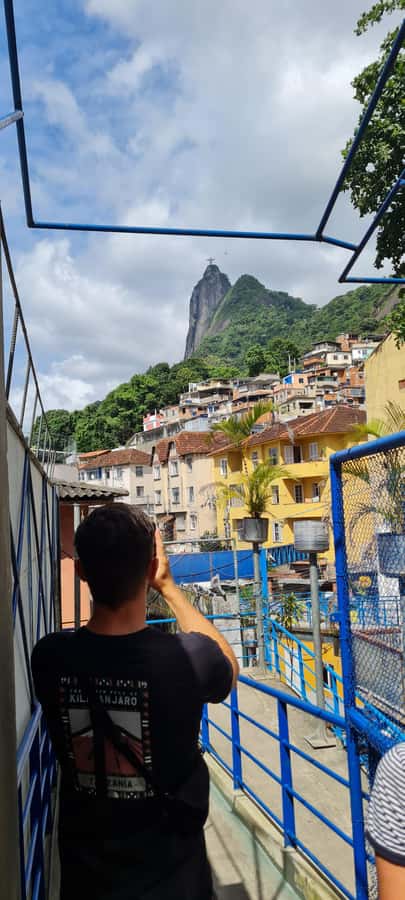
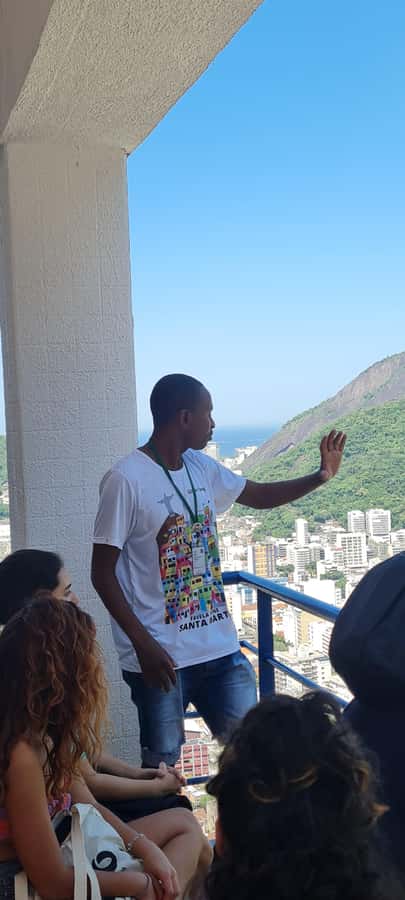
The high points are among the clearest rewards of the tour. From Santa Marta, you can see toward Christ the Redeemer and Sugarloaf Mountain, two of Rio’s most recognizable sights.
This view gives you a useful change of perspective. Instead of looking at the favela from a distant viewpoint, you look outward from within the community. The city’s famous landmarks remain visible, but they share the view with rooftops, hillside homes, narrow passages, and the dense urban fabric below.
There are scheduled photo stops, including one of about ten minutes at a viewpoint and another around R. da Paciência. These pauses are short, so you may want to take photos efficiently and then return your attention to the explanation.
Clear weather will make a big difference. On a hazy or rainy day, the view may be less dramatic, though the neighborhood itself remains the main subject of the visit. One guide continued the route in heavy rain, which shows that the tour can operate in poor weather, but your comfort may vary.
A few more trips worth weighing up before you book
- Rio de Janeiro: 6-Stop Highlights of Rio with Lunch
★ 4.4 · 5,157 reviews - Christ the Redeemer Entry Ticket by Corcovado Train
★ 4.4 · 4,476 reviews - Rio: Christ the Redeemer, Sugarloaf, Selaron & BBQ Lunch
★ 4.5 · 2,428 reviews - Rio de Janeiro: Angra dos Reis and Ilha Grande Full-Day Tour
★ 4.6 · 1,673 reviews
The family home and the famous clock collection
One of the most memorable parts can be a visit to Gilson’s home. The house has three floors, including a home-stay area and a rooftop space used for social dining, drinks, and snacks.
His mother, Maria Helena, is known for collecting clocks. More than 400 clocks are displayed throughout the home. This is the sort of detail that gives the tour a personal center. You are not only hearing general information about housing and architecture. You are seeing how one family has adapted and built within the community.
The house also helps explain the practical side of life in Santa Marta. The tour description points to construction, home design, and the way the building has developed over time. You may find this more revealing than a polished architectural presentation because it is tied to a real family and a working home.
At the rooftop space, you can take in views of Christ the Redeemer and Sugarloaf while having drinks or local snacks, depending on what is available during your visit. Food and drinks beyond the included bottled water should not be assumed as part of the $27 price, so carry some Brazilian reais if you want to buy something locally.
Daily life, local projects, and community work
The strongest reason to choose this tour is its attention to ordinary life. You may see children playing football, hear about school and local services, and learn how residents spend their free time.
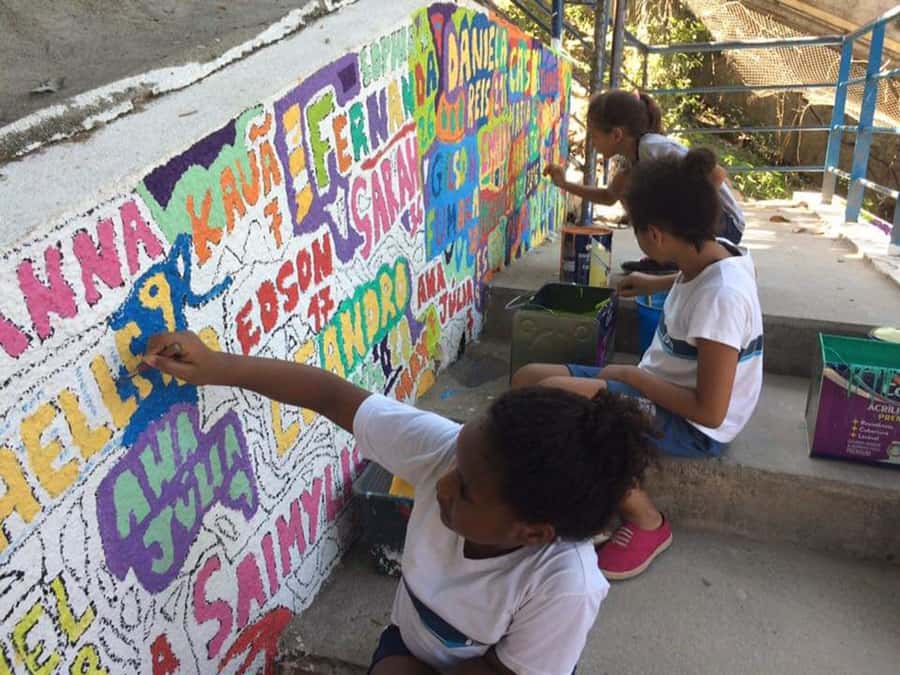
The route can include simple activities such as football, spinning tops, marbles, kite flying, or a drum session on a rooftop. These details matter because they show Santa Marta as a place where people live, socialize, and raise families. The neighborhood is not defined only by poverty, policing, or famous visitors.
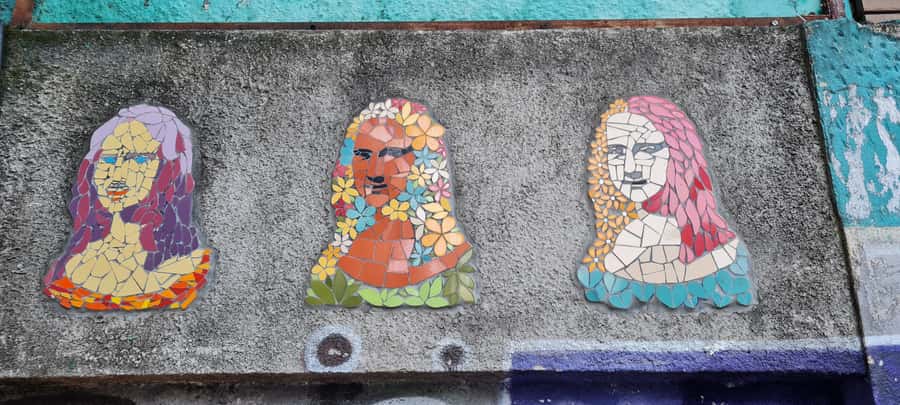
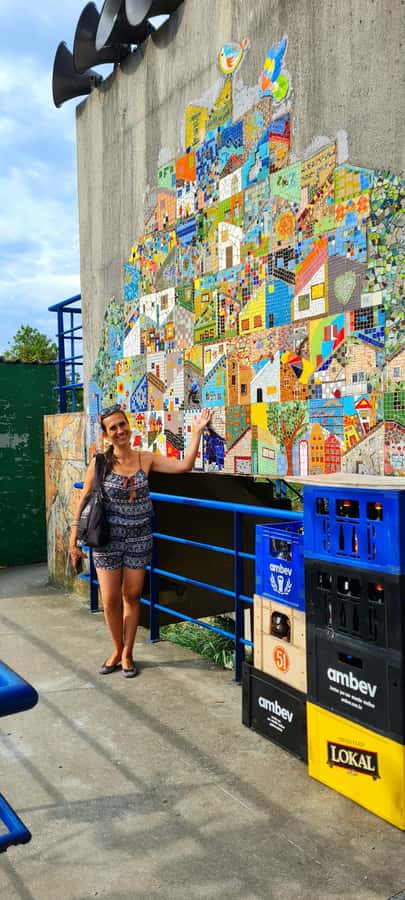
Gilson and other residents are involved in educational, language, artistic, and environmental work. The Institute Gilson Fumaça is connected with these efforts, including English and Spanish classes. Other projects involve mosaics, music, art, and planned cooking activities.
This is where the social purpose becomes practical. A good community tour should leave money and attention in the place being visited. Here, the guide’s work and local projects are presented as part of the same effort. Your booking supports the activity of a resident guide and helps maintain the wider community work.
You should still approach the visit with respect. Do not expect every project to be open every day, and do not treat children or residents as part of the entertainment. The most worthwhile moments come from conversation and context, not from collecting unusual photographs.
Local food, shopping, and Michael Jackson Square
The route includes a visit to a local restaurant. This gives you a chance to see how the neighborhood serves food and social life, rather than stopping only at viewpoints. The exact meal or menu is not specified, so think of this as a local stop rather than a guaranteed full lunch.
Michael Jackson Square is another planned pause. You have about 15 minutes for free time, photos, and possible shopping. The square is linked to the filming of They Don’t Care About Us, which made Santa Marta recognizable around the world.
The music video brought major attention to the community. The tour adds meaning by connecting that global moment with Gilson’s own experience. He was close to the filming and can place the event within the neighborhood’s story.
The square is a good spot for photos, but it should not be the entire focus of the visit. If you only want the music-video location, you can find shorter sightseeing options. This tour is better suited to you if you want the square as one part of a broader look at Santa Marta.
Safety, comfort, and the right attitude
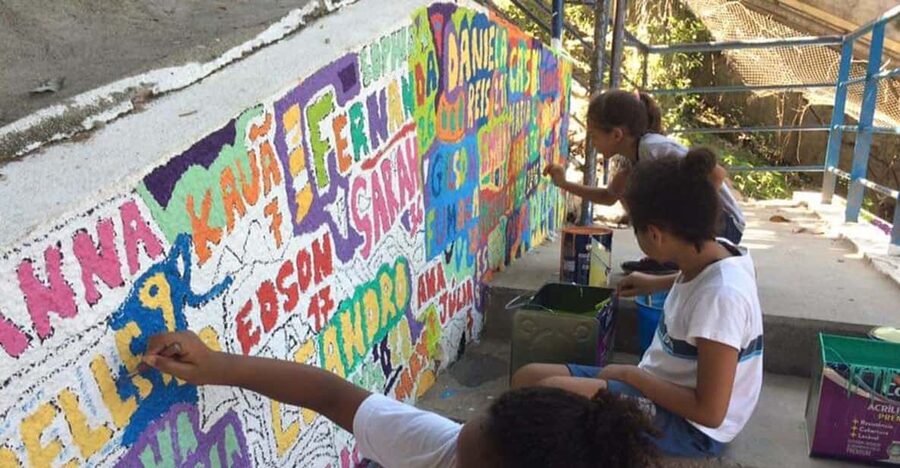
Safety is a common concern when people first consider visiting a Rio favela. This tour addresses that concern through a local guide who is well known in Santa Marta and who can explain how to move through the area respectfully.
The guide’s relationships with residents can help you feel more at ease. Still, a guided visit is not a promise that every situation will be predictable. Listen carefully to the safety briefing, stay with the group, and follow local instructions.
Dress for Rio’s heat. Light clothing, sunscreen, sturdy shoes, and a small bag are sensible choices. Avoid carrying flashy valuables. The route includes stairs, uneven surfaces, and uphill walking, so this is not the day for sandals with little support.
The tour can be conducted in English, Spanish, or Portuguese. That language choice is important because the experience depends heavily on explanation and conversation. If you speak Portuguese, you may enjoy an even more direct connection with residents, but English and Spanish are available.
The expected duration is roughly two to two and a half hours. Some visits may run longer when conversations, family introductions, football, or community activities develop naturally. One group planned for a short outing but stayed much longer because the experience became more social. Do not book it immediately before a fixed appointment.
Is $27 good value?
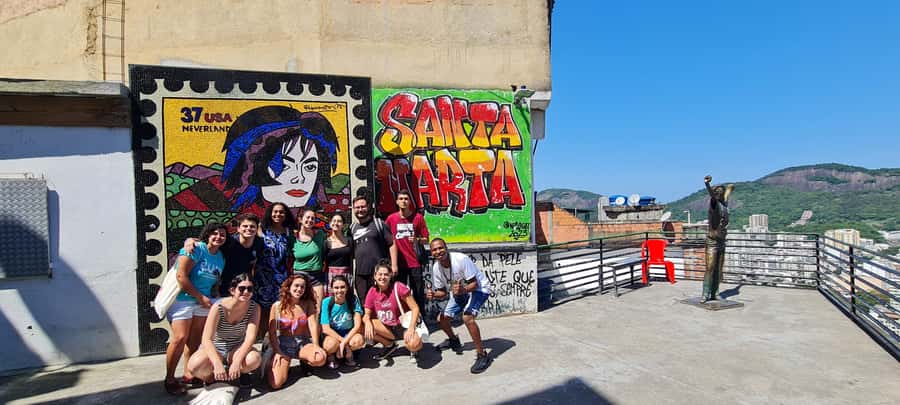
At $27 per person, this is fairly priced for a resident-led walking tour with a cable car segment, bottled water, a local restaurant stop, several viewpoints, and a guide working on community projects.
The real value is not the number of stops. It is the access to a personal story and a neighborhood guide who has lived in Santa Marta since childhood. You are paying for interpretation, local relationships, and a form of tourism intended to return benefits to the community.
It is less suitable if you want a polished sightseeing product with strict timing and minimal walking. The schedule may feel flexible, and the most memorable parts can come from conversation rather than a formal attraction.
The price also compares well with the social purpose of the experience. Your money goes to a local operator rather than only to a large outside company. The tour’s educational and cultural projects give the visit a purpose beyond sightseeing.
Cancellation is flexible: you can cancel up to 24 hours before the activity for a full refund, and reserve now while paying later. That is useful if your Rio schedule depends on weather or changing plans.
Who should book the Santa Marta tour?
I would choose this experience if you want to understand how a Rio favela works from the perspective of someone who lives there. It suits curious visitors who are ready to listen, ask respectful questions, and accept that the neighborhood is a home first and an attraction second.
It is especially good for people interested in:
- Social and economic change in Rio
- Community education and youth projects
- Local architecture and family life
- Music-video history and popular culture
- Small-group experiences with personal storytelling
- Views of Christ the Redeemer and Sugarloaf from a different angle
I would think twice if you have limited mobility, dislike stairs, or struggle in hot weather. I would also avoid booking it if you want a quick photo stop with no serious discussion.
Should you book it?
Yes, if you want a personal and socially focused introduction to Santa Marta. Gilson Fumaça’s background, family home, local connections, and work with education projects give the route a human focus that a guide from outside the community could not easily match.
Book it for a clear, cooler day if possible, and leave room in your schedule. Bring water, wear proper shoes, and arrive ready to treat Santa Marta as a real neighborhood. If you do that, the $27 price buys much more than a view and a famous wall. It gives you a chance to understand a part of Rio through the people who call it home.
FAQ
Where does the Santa Marta tour meet?
The meeting point is listed at R. São Clemente, 320, near the tourist information point. The exact meeting location can vary depending on the option booked.
How long does the tour last?
The stated duration is between two hours and 150 minutes. Some visits may take longer if conversations and local activities continue naturally.
Which languages are available?
The tour is offered in English, Spanish, and Portuguese.
Is a local guide included?
Yes. A local guide is included, and the experience is led by Gilson Fumaça, who was born and raised in Santa Marta.
Is bottled water included?
Yes. Bottled water is included in the tour.
Is the cable car ride part of the experience?
Yes. The itinerary includes a cable car segment lasting about 20 minutes.
Will I see the Michael Jackson filming location?
Yes. The route includes Michael Jackson Square, connected with the filming of They Don’t Care About Us in Santa Marta.
Is the tour suitable for wheelchair users?
No. The experience is not suitable for wheelchair users or people with mobility impairments because it includes stairs and steep walking.
Can I cancel and receive a refund?
Yes. You can cancel up to 24 hours before the activity for a full refund.
Just added around Rio de Janeiro
- Pedra Bonita Trail: The easiest trail with a beautiful view of Rio★ 4.6 · 3 reviews
- Rio: Private, Custom express, Main Attractions!★ 5.0 · 3 reviews
- Rocinha Jeep Tour: A Journey into the Soul of the Favela!★ 3.8 · 3 reviews
- Rio: Favela Walking Tour of Rocinha with a Resident Guide★ 4.7 · 3 reviews
- Explore Fernando de Noronha: 7-Hour Ilhatour★ 4.9 · 3 reviews
- Rio: Museum of Tomorrow, Yup Star & Olympic Boulevard★ 3.7 · 3 reviews
- Rio: Best Dive Experience All Inclusive Scuba Diving Package★ 5.0 · 3 reviews
- Rio de Janeiro by Air: 10-Minute Helicopter Tour★ 4.4 · 3 reviews
Favela Tours, compared.


Favela Rocinha Tour with Local Guide & Secret Spots
Read our review →
Favela Tour The Original, Rocinha & Vila Canoas since 1992
Read our review →
Sunrise at Morro 2 Irmãos – Vidigal – Rio de Janeiro
Read our review →Browse the lists this tour appears in