
Reviewed · MUSEUMS
Official Ticket: Oceanographic Museum Univali – Piçarras – SC
The ocean gets its own seven-wing museum. At Univali Oceanographic Museum in Piçarras, you move from fossils and early ocean science to sharks, turtles, seabirds, whales, and live aquarium animals. I like the clear subject-based layout and the rare specimens, especially the white shark jaw and deep-sea fish. I also like the sensory experience with marine animals, which gives children and adults something more active than a display case.
The main drawback is that some displays lack enough explanation, and the galleries can feel too dark for easy reading. The aquarium sections may also seem modest if you expect large tanks packed with fish. At about $15.68 per person, this is best for visitors who enjoy natural history and marine science, not for anyone seeking a fast, entertainment-heavy attraction.
In This Review
- Key points to know before you go
- Why the Univali museum is worth your time
- Entering through the Blue Wing
- The Red Wing brings small sea life into focus
- The Green Wing puts sharks and rays on display
- The Brown Wing ranges from tarpon to abyssal fish
- The Gray Wing tells Brazil’s sea turtle story
- The Beige Wing gives seabirds room to fly
- The Black Wing covers whaling, whales, and manatees
- The Ocean Giants panel changes the scale
- The touch experience adds a family-friendly moment
- What $15.68 buys you
- Planning your afternoon in Piçarras
- Who should book this museum
- Should you book the Univali Oceanographic Museum?
- FAQ
- Where is the Univali Oceanographic Museum located?
- How long does a visit take?
- What are the museum’s opening hours?
- What does admission include?
- Is an educational package included?
- Are service animals allowed?
- Can I cancel for a refund?
Key points to know before you go
- Seven marine-life wings: The route covers ocean origins, invertebrates, sharks and rays, bony fish, reptiles, seabirds, and mammals.
- Rare specimens: Highlights include Brazil’s only displayed great white shark jaw, deep-sea fish from below 2,000 meters, and preserved giant squid material.
- Live aquarium displays: Several wings pair preserved specimens with living animals and habitat-based aquariums.
- A strong turtle section: All five sea turtle species found in Brazil are represented, from young turtles to giant adults.
- Hands-on marine contact: The sensory experience can be a real highlight for families, though its value may depend on your expectations.
- Practical timing: The museum is open Tuesday through Sunday from 2:00 PM to 5:30 PM, and most people need about one to one and a half hours.
Why the Univali museum is worth your time
Piçarras is known for its coastal setting, and this museum gives you a useful way to understand the sea beyond the beach. Instead of focusing on a single animal, the exhibition follows the whole marine system, from tiny invertebrates to the blue whale, the largest animal ever known to have lived on Earth.
I like that the collection brings together more than 1,400 pieces. That number matters because you get a broad look at Brazilian marine biodiversity rather than a small set of familiar shells and mounted fish. The displays also include live animals, so the visit has movement and color alongside fossils, skeletons, shells, teeth, and preserved specimens.
The museum works best when you take your time. You can finish the main circuit in about an hour, but allowing up to 90 minutes gives you more time to read, look at the aquariums, and stop at the sensory activity. If you rush, the displays may blur into one long procession of specimens.
More museums and galleries:
- Petrópolis Day Trip from Rio de Janeiro including Imperial Museum and Crystal Palace
★ 4.0 · 101 reviews - 7-Hour Shared Group Santos Tour : Mont Serrat, Coffee Museum and Sightseeing
★ 5.0 · 68 reviews - Olympic Boulevard, Museum of Tomorrow & Historical Rio
★ 4.5 · 66 reviews
Entering through the Blue Wing
The Blue Wing begins with the emergence of life and the science of oceanography. Fossils from different geological ages put the story of life into a long time frame. You are not just looking at modern sea creatures. You are seeing how marine life fits into the history of the planet.
This section also connects the sea to human culture. Historical pieces show how ancient societies viewed the ocean, while displays about voyages of discovery explain how people gradually mapped and crossed it. The final part introduces modern technologies used to explore the sea.
I find this a useful opening because it sets up the rest of the museum. The sharks, rays, turtles, and whales later in the circuit are not isolated curiosities. They are part of a much older story of adaptation and exploration.
The Blue Wing may appeal most to adults and older children who enjoy fossils, history, or science. Younger children may prefer the live animals in later areas, so families can keep the opening section moving and spend more time where interest is highest.
The Red Wing brings small sea life into focus
Marine invertebrates fill the Red Wing. This includes sponges, corals, mollusks, echinoderms, and crustaceans. The presentation pairs calcareous structures with aquariums containing living examples of related animals.
That pairing is one of the better ideas in the museum. A shell or coral skeleton can look like a beautiful object, but a live aquarium helps you understand that it once belonged to an active animal with a particular shape and way of life.
Look for mollusk shells with striking forms and colors, sea stars, sea urchins, sea cucumbers, shrimp, crabs, and lobsters. A preserved giant squid is one of the more unusual specimens. It gives the section a sense of scale and reminds you that the ocean is not made only of small creatures close to shore.
The weakness here is labeling. Some pieces may have less explanation than you want, especially if you are trying to identify a particular species or understand why its body has a certain shape. I would treat the Red Wing as a visual introduction and not expect a full label beside every object.
The Green Wing puts sharks and rays on display
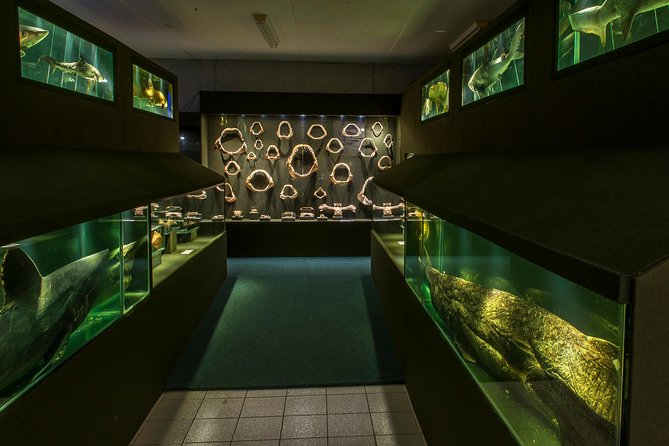
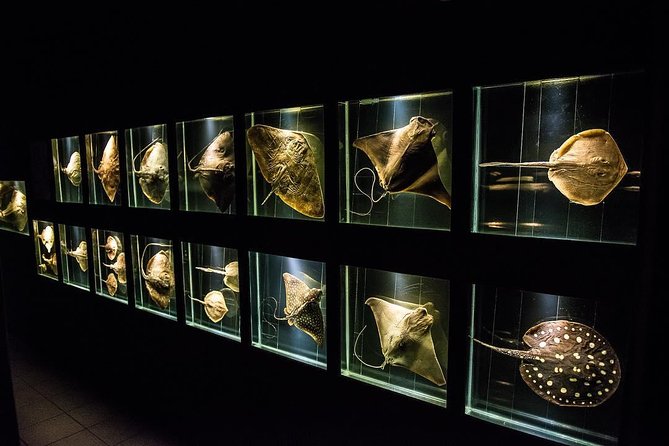
The Green Wing focuses on cartilaginous fish, including sharks and rays. You see coastal species, deep-sea forms, and endangered animals, along with teeth and jaws that show how these predators feed.
The biggest talking point is the great white shark jaw described as the only one on display in Brazil. It is an arresting sight, even for people who are not especially interested in sharks. The section also explains reproduction, a useful addition because it shows how different sharks and rays manage life in varied marine habitats.
Four aquariums represent the environments where these animals live. Live displays make the subject less abstract, particularly for children who may understand a shark better when they see its movement rather than only its teeth.
This wing is also a good reminder that sharks are more varied than the standard movie image. The collection includes different body forms and habitat preferences. If you have limited time, I would give this area a careful look, along with the turtle and mammal sections.
A few more trips worth weighing up before you book
- Christ the Redeemer Entry Ticket by Corcovado Train
★ 4.4 · 4,476 reviews - Rio de Janeiro: Sugarloaf Cable Car Official Ticket
★ 4.6 · 2,873 reviews - Rio: Maracanã Stadium Official Entrance Ticket
★ 4.4 · 1,632 reviews - Canela Cable Car Park Ticket
★ 4.0 · 1,030 reviews
The Brown Wing ranges from tarpon to abyssal fish
The Brown Wing covers bony fish, the huge group that includes many familiar marine species. The displays show different body shapes and adaptations, with larger examples such as tarpon and oceanic swordfish.
The collection includes fish from the Indian and Pacific oceans in its aquarium group. That gives the section a wider reach than a display limited to southern Brazil. You can compare forms from different parts of the world and consider how fish bodies suit their surroundings.
The most unusual material is the deep-sea fish display. These animals live in the abyssal zone more than 2,000 meters below the surface, a place with conditions far removed from the shallow water most people know. Even without elaborate technology or a dramatic presentation, the subject itself is memorable.
Some specimens are shown mainly as preserved bodies or skeletons. If you want more context, check the labels closely. The museum’s strongest displays combine specimens with good explanations, but the amount of information is not consistent across every species.
The Gray Wing tells Brazil’s sea turtle story
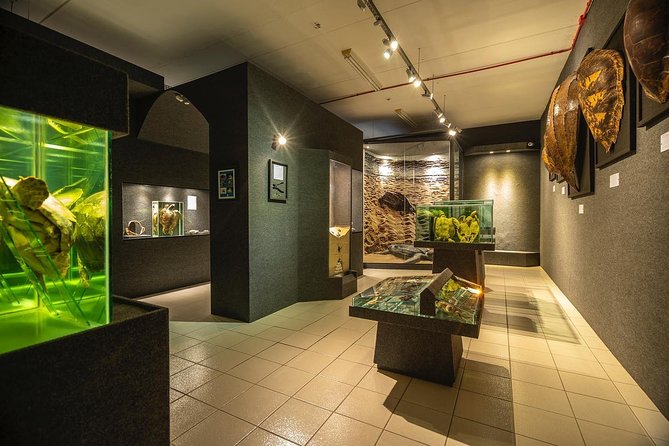
The Gray Wing is devoted to marine reptiles, with sea turtles at its center. Brazil has five sea turtle species, and all five are presented here.
This is one of the clearest sections for families. The exhibition covers several stages of turtle life, from small young animals to very large adults. You can also find information about biology and ecology, so the section moves beyond simple identification.
The size range helps you understand the long process of growth. A young turtle and a giant adult can look like completely different animals, yet the display connects them within one life cycle. For children, this can turn a familiar symbol of ocean conservation into something more specific and memorable.
I would allow extra time here if sea turtles are a particular interest. The collection is described as the most complete display of its kind assembled at the museum, and it offers more substance than a single mounted specimen with a short caption.
The Beige Wing gives seabirds room to fly
The seabird section explores the biology and ecology of several species. All penguin species are represented, with attention to their distribution across the Southern Hemisphere.
The centerpiece is a diorama of an oceanic island featuring endangered wandering albatrosses. That display helps explain how seabirds use remote islands for breeding and how their lives depend on open water over long distances.
The penguin material is likely to catch the attention of younger visitors, but the albatross display gives the wing its strongest sense of place. It shows that marine life includes animals that spend much of their lives above the water, not only those swimming below it.
As in other parts of the museum, the quality of the experience depends partly on how much information you want to read. You may find certain images or specimens have limited text. For a quick visit, focus on the penguins and the island diorama, then move on if the labels do not hold your interest.
The Black Wing covers whaling, whales, and manatees
The marine mammal wing begins with the history of whaling and commercial exploitation. That subject has special relevance in Santa Catarina, where whaling was once widely practiced.
Starting with this difficult part of the region’s past gives the wing a useful context. It shows that ocean history is not only about discovery and admiration. Human use of marine animals has caused serious pressure on populations, and the exhibition places that history before its displays of dolphins and whales.
You then encounter species found in southern Brazil, with information about their biology. South American fur seals and sea lions are also included, along with manatees from northeastern Brazil.
This section can work for both adults and children because it combines large, recognizable animals with a local historical connection. I would not expect live whales or an aquarium-scale spectacle. The value is in seeing specimens and learning how these animals relate to Brazil’s waters and coastal communities.
The Ocean Giants panel changes the scale
Outside the museum, a full-scale panel presents the largest marine animals from each major group. It gives you a chance to compare their size in a way that smaller cases cannot.
The blue whale is the star. At 33 meters long and about 170 tons, it is described as the largest animal ever to live on Earth. Those numbers can feel remote on a page, but a full-scale presentation makes the length easier to grasp.
Do not skip this outdoor section simply because it is outside the main galleries. It provides a useful final image after you have seen small shells, fish, turtles, and preserved mammals. You leave with a clearer sense of the range of marine life, from tiny organisms to an animal longer than many buildings.
The touch experience adds a family-friendly moment
Admission includes a sensory experience with marine animals. This is often the most interactive part of the visit, and it can appeal to adults as much as children.
For families, the chance to have direct contact with the marine world can make the museum feel more personal. A child who moves quickly past a case may stop and pay attention when the visit includes a hands-on element.
I would keep expectations measured. The sensory activity is not the entire museum, and it may not be the main reason to pay admission if you prefer large aquariums or polished interactive technology. Still, it adds variety to a visit that otherwise relies heavily on displays and labels.
The educational package for groups costs extra, so the standard admission does not include a separate guided school-style program. That matters if you are arranging a group visit and want structured teaching materials.
What $15.68 buys you
At roughly $15.68 per person, the museum offers a full hour or more of indoor activity, a collection of over 1,400 pieces, live aquariums, the touch experience, and access to the outdoor Ocean Giants panel.
I consider that fair value for people who already enjoy marine life, fossils, or natural history. The broad subject range means you are not paying to see only one type of animal. You also get unusual material, including the great white shark jaw, giant squid specimen, deep-sea fish, and all five Brazilian sea turtle species.
The value is less certain if you judge museums by aquarium size or visual polish. Some aquarium displays may contain fewer fish than you expect, and dark lighting can make certain pieces or captions harder to see. Several areas also need more information beside the specimens.
My advice is simple: book it for the collection and the chance to learn, not for a large entertainment venue. If you have an empty afternoon in Piçarras, the price is easier to justify. If your family wants nonstop activity, you may finish with mixed feelings.
Planning your afternoon in Piçarras
The museum is open Tuesday through Sunday from 2:00 PM to 5:30 PM during the stated operating period, which runs from December 1, 2025, through February 28, 2027. There is no Monday opening listed, so check the date before arranging your afternoon.
The hours are fairly narrow. You cannot simply drop in at any time of day, and the limited schedule was a concern for some people. I would aim to arrive with enough time for the full 60 to 90 minute circuit rather than arriving near closing.
Most people can take part, and service animals are allowed. Confirmation is provided when you book. Free cancellation is available if you cancel at least 24 hours before the start time. A cancellation inside that window is not refunded, and changes made during the final 24 hours are not accepted.
Who should book this museum
I would recommend the Univali Oceanographic Museum to:
- Families with children who like animals, fossils, and hands-on activities
- Visitors interested in Brazil’s marine species
- Anyone who enjoys natural history collections
- People looking for an educational indoor stop in Piçarras
- Sea turtle, shark, whale, seabird, or shell enthusiasts
I would be more cautious if you want bright galleries, extensive text beside every object, or aquariums filled with large numbers of fish. The museum has impressive specimens, but presentation quality varies from one section to another.
Should you book the Univali Oceanographic Museum?
Book it if you can give it about 90 minutes and you want more than a quick photo stop. The seven-wing route, live animals, rare specimens, turtle collection, and full-scale blue whale panel give the visit real substance.
I would especially choose it for a family with a child who already loves marine animals. The sensory experience can turn a quiet museum visit into something more memorable. For adults, the best reasons are the scientific range and the links to Santa Catarina’s whaling past.
Skip it if your schedule is tight, the afternoon hours do not fit, or you expect a major public aquarium. At this price, it is a solid specialist museum with a few presentation flaws, not a polished theme attraction. Go with curiosity, allow enough time, and pay close attention to the standout specimens.
FAQ
Where is the Univali Oceanographic Museum located?
The museum is in Piçarras, in Santa Catarina, in southern Brazil.
How long does a visit take?
The expected visit lasts about one hour to one and a half hours.
What are the museum’s opening hours?
It is open Tuesday through Sunday from 2:00 PM to 5:30 PM during the listed operating period from December 1, 2025, through February 28, 2027.
What does admission include?
Admission includes access to the exhibition and the sensory experience with marine animals.
Is an educational package included?
No. The educational package is available for groups but is not included with standard admission.
Are service animals allowed?
Yes, service animals are allowed.
Can I cancel for a refund?
Yes, you can receive a full refund if you cancel at least 24 hours before the experience start time. Cancellations within 24 hours and changes made within 24 hours are not accepted for a refund.
Just added around Brazil
- Idyllic Islands Private Speedboat Tour in Paraty★ 5.0 · 3 reviews
- Pedra Bonita Trail: The easiest trail with a beautiful view of Rio★ 4.6 · 3 reviews
- Campos do Jordão: Full-Day Private Tour from São Paulo★ 5.0 · 3 reviews
- Itacare: Jeribucaçu Trail and Usina Waterfall★ 4.7 · 3 reviews
- Paraty: Half-Day Bike Rental★ 3.6 · 3 reviews
- Walk to the Big Rock in Cantareira State Park★ 5.0 · 3 reviews
- Rio: Private, Custom express, Main Attractions!★ 5.0 · 3 reviews
- Rocinha Jeep Tour: A Journey into the Soul of the Favela!★ 3.8 · 3 reviews
Museums, compared.

Petrópolis Day Trip from Rio de Janeiro including Imperial Museum and Crystal Palace
Read our review →
7-Hour Shared Group Santos Tour : Mont Serrat, Coffee Museum and Sightseeing
Read our review →
Olympic Boulevard, Museum of Tomorrow & Historical Rio
Read our review →
Olympic Boulevard, AquaRio and Museum of Tomorrow Tour
Read our review →
Olympic Boulevard, Museum of Tomorrow & History Tour
Read our review →
Petrópolis Trip with Palace, Imperial Museum & Brewery
Read our review →
Museum of Tomorrow Guided Tour, Admission & Transfer
Read our review →
MUSA and INPA Museums with Observation Tower Tour
Read our review →Browse the lists this tour appears in