Reviewed · RIO DE JANEIRO TOURS
Jewish Tour in Rio de Janeiro
Rio has a Jewish story worth finding. This three-hour outing links synagogues, community centers, memorials, and beaches that most city tours skip, while a local guide explains how Jewish life took root in Brazil. I especially like the hotel or port pickup and the small group size, capped at 14 people. The main caution is that the experience depends heavily on the guide and on which sites are open that day.
I also like the range of Jewish traditions represented. You may see an Orthodox synagogue, a Progressive congregation, a major community center, and the old Ashkenazi Great Temple of Israel in one morning. At $95 per person, it is not a cheap sightseeing ride, but the price can make sense if you want access to scattered sites without arranging several taxis yourself.
In This Review
- Key points about this Rio heritage tour
- Why Rio’s Jewish story takes a little effort to find
- Starting in Leblon and Ipanema
- Botafogo’s Anne Frank connection and ARI synagogue
- The view from Itzhak Rabin Park
- Inside the Jewish Museum of Rio de Janeiro
- The Great Temple of Israel and its changing role
- Guides make the difference
- Is $95 a fair price?
- Who should book this experience?
- Should you book the Jewish Tour in Rio?
- FAQ
- How long does the Jewish Tour in Rio de Janeiro last?
- What time does the tour start?
- Is hotel pickup included?
- What is the maximum group size?
- Are entrance fees included?
- Can I cancel for a full refund?
Key points about this Rio heritage tour
- Three hours across several neighborhoods: The route connects Leblon, Ipanema, Copacabana, Botafogo, and central Jewish sites by car or van.
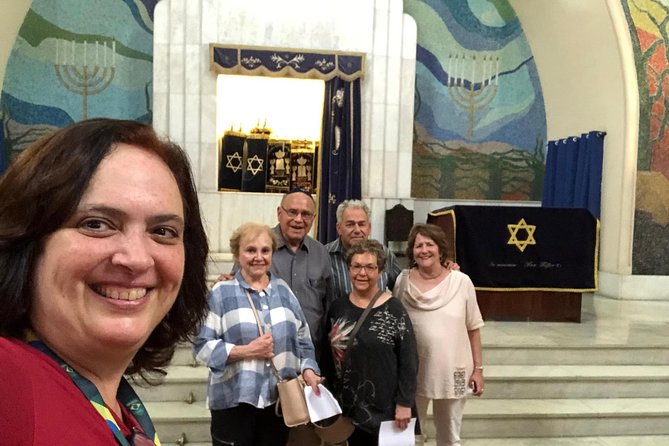
- Several branches of Jewish life: The itinerary includes Beit Lubavitch, the ARI Progressive synagogue, the CIB Jewish Community Center, and the Great Temple of Israel.
- A local perspective matters: Guides such as Efraim, Leonardo, Gisella, and Eduardo have been praised for personal stories, warm introductions, and clear explanations.
- A small group keeps the outing manageable: The vehicle holds no more than 14 people, giving you more room for questions than a large bus tour.
- The Jewish Museum may be modest in size: Its exhibits and research material are useful, but the museum can feel small compared with the importance of Rio’s Jewish population.
- Opening conditions can change the morning: The Great Temple is generally open only for High Holidays, special events, and scheduled visits, while the Rabin Park area has had access problems.
Why Rio’s Jewish story takes a little effort to find
Rio is usually sold through its famous sights: Sugarloaf, Christ the Redeemer, the beaches, and the old center. Jewish life is spread across the city, so seeing it independently would mean piecing together locations in several neighborhoods and working out which religious buildings welcome visitors.
That is the practical reason to take this tour. You ride between sites in an air-conditioned car or van instead of spending your morning navigating Rio traffic. The guide supplies the links between places, from immigrant settlement and synagogue life to present-day community institutions.
This is also a city tour in disguise. The route follows some of Rio’s best-known coastal neighborhoods, including Leblon, Ipanema, Copacabana, and Botafogo. As you move between Jewish sites, the guide can point out parts of the city beyond the usual postcard stops.
The human side is a major part of the experience. Efraim has been praised for making visitors feel personally welcomed, while Leonardo has been described as animated and generous with explanations. Other guides named by customers include Gisella, Katya, Eduardo, and Victoria. The quality is not entirely uniform, so I would pay close attention to the guide assigned to your departure.
A few more trips worth weighing up before you book
- Rio de Janeiro: 6-Stop Highlights of Rio with Lunch
★ 4.4 · 5,157 reviews - Christ the Redeemer Entry Ticket by Corcovado Train
★ 4.4 · 4,476 reviews - Rio de Janeiro: Rocinha Favela Walking Tour with Local Guide
★ 4.8 · 3,052 reviews
Starting in Leblon and Ipanema
The morning begins at 9:00 a.m., with the advertised meeting point at the Hilton Rio de Janeiro Copacabana. Pickup and drop-off are also available at selected hotels and at the port, but you should confirm the exact location and time before the morning begins.
The first neighborhood is Leblon, one of Rio’s most expensive addresses. Here, the Jewish focus is Beit Lubavitch Synagogue and the Midrash Cultural Center. The scheduled stop is about 20 minutes and has no admission charge.
Do not expect a long museum visit here. This is a short orientation stop, useful for placing Orthodox Jewish life within Rio’s modern residential districts. If the building is open for entry, you may receive more context inside. If not, the value comes from the guide’s explanation and the chance to see where this part of the community functions.
The route also passes through Ipanema. The beach runs between Arpoador and Leblon and is one of the city’s main gathering places. Its high property prices and polished reputation make it a helpful contrast to the religious and communal sites you visit.
Another beachside stop brings you to Copacabana and the CIB Jewish Community Center. The center is one of the most interesting parts of the outing because it shows Jewish life as an everyday social network, not only as worship.
One detailed account described facilities that include a gymnasium, workout room, restaurant, shop, pharmacy, games, and card rooms. The center is also open to people of different faiths. That combination gives you a useful picture of how a community institution can support social, cultural, and practical needs in one place.
The center may also be especially meaningful if you are comparing Jewish life in Rio with your own community at home. It is not merely a religious building. It is a place for exercise, meals, social contact, learning, and daily assistance.
Botafogo’s Anne Frank connection and ARI synagogue
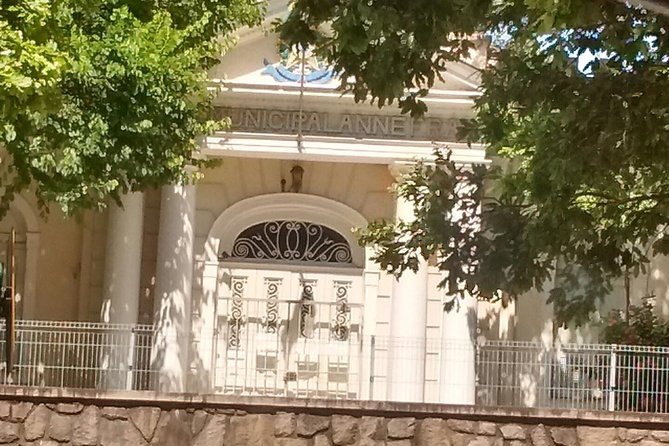
The tour then moves to Botafogo Beach, where the view across the bay is one of Rio’s classic scenes. The Jewish connection here includes a municipal school named for Anne Frank.
The school forms part of the Anne Frank Schools Network, working with Brazil’s national Jewish organization, CONIB, and other groups. The goal is to promote peace, respect for differences, and human rights in public education. This stop gives the tour a wider purpose: Jewish history is not presented only as an internal community matter, but also as a lesson connected to civic life.
The Botafogo stop usually lasts around 30 minutes and has no listed admission fee. The setting also gives you a chance to take photographs, though the tour’s emphasis remains explanation rather than a long beach visit.
You may also visit the ARI synagogue in this area. ARI, founded in 1942, represents Progressive Judaism in Rio and is affiliated with the World Union for Progressive Judaism. Its community center, opened in 1997, includes classrooms, a library, auditorium, offices, and the Henrique Peres Synagogue, which can seat up to 150 people.
The center also houses the Zinner Family Center for Reference and Research on the Holocaust. This is one of the places where the tour can become more personal and serious. It connects religious practice with study, remembrance, and research.
Access can vary. One account described the Holocaust-related area as closed on the day of the visit, so you should treat entry as possible rather than guaranteed. If the building is closed, the guide’s explanation still gives the site meaning, but the morning will feel less complete than when the interior spaces are available.
A useful point here is the contrast between ARI and Beit Lubavitch. You are not seeing one single version of Judaism in Rio. You are seeing different approaches to worship, community, and Jewish identity within the same city.
The view from Itzhak Rabin Park

At Botafogo Bay, the route includes Itzhak Rabin Park on Morro de Pasmado. The park was named for Israel’s former prime minister and inaugurated by his wife, Leah Rabin.
The hilltop location gives views toward Botafogo Bay and Urca Bay. A bust of Rabin marks the connection between Brazil and Israel. This is a short 20-minute stop, with the view doing as much work as the monument.
The practical warning is important: access to the park has not always been available. One account found the area inaccessible at the time of the visit. Ask the guide about current conditions rather than building your expectations around a guaranteed viewpoint.
Even when the park itself cannot be entered, the stop helps explain how Jewish identity in Rio connects to international Jewish life and to Brazil’s relationship with Israel. It is also a welcome outdoor pause after several indoor locations.
A completely different kind of day out around Rio de Janeiro:
- Rio: Christ the Redeemer, Sugarloaf, Selaron & BBQ Lunch
★ 4.5 · 2,428 reviews - Rio De Janeiro: Half-Day Rocinha Favela Walking Tour
★ 4.7 · 2,272 reviews - Rio de Janeiro: Angra dos Reis and Ilha Grande Full-Day Tour
★ 4.6 · 1,673 reviews - Rio: Maracanã Stadium Official Entrance Ticket
★ 4.4 · 1,632 reviews
Inside the Jewish Museum of Rio de Janeiro
The Jewish Museum is scheduled for about 30 minutes, and admission is not included in the tour price. You should be prepared to pay the entrance fee separately if the museum is open and operating under normal conditions.
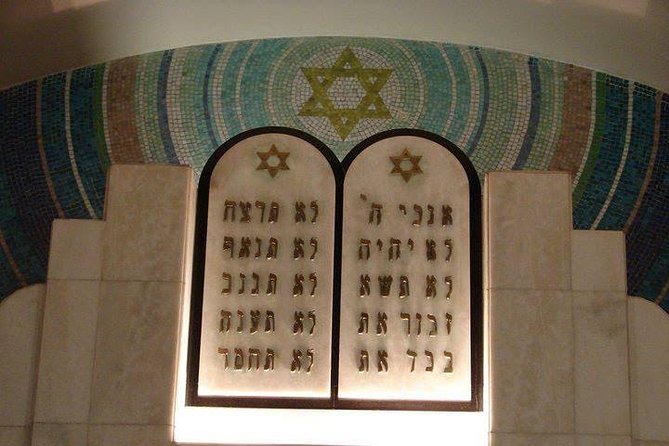
The museum began in 1977 after the donation of a menorah, the seven-branched candelabrum that is one of Judaism’s central symbols. Its work covers Jewish traditions, migration, community history, and the Holocaust.
The collection is not presented as a huge national museum. It functions more like an active cultural and research center. Along with exhibits, it has a study center, library, research work on migration and the Holocaust, student competitions, and a video archive containing more than 1,000 films.
That makes the museum important even if the physical display feels compact. One account described it as a small space in an office building. I would not come expecting grand galleries. I would come for the documents, objects, and local focus.
The short time allotment means you should listen carefully to the guide before wandering. Some visitors have found the museum to be a highlight because it supplies the historical framework that the synagogues alone cannot provide. Others may wish for more time, especially if the exhibits are open and there is a lot to read.
The Great Temple of Israel and its changing role
The final major stop is the Grande Templo Israelita do Rio de Janeiro, an Ashkenazi synagogue with an important place in the city’s Jewish story.
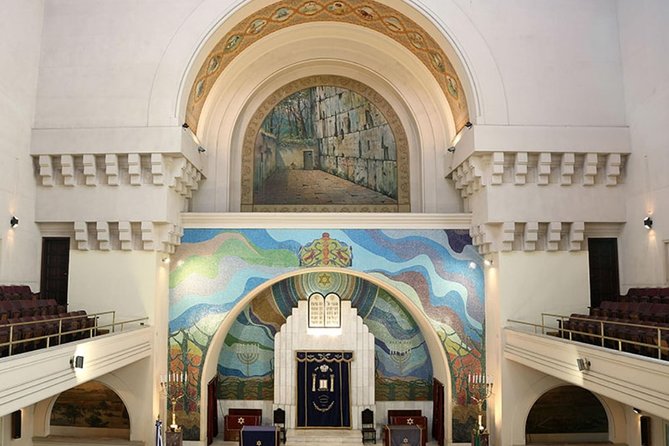
The building was designed in 1919 by an architect named Vodred and opened in 1932. Its style combines classical elements with Hebrew references. Mosaics added in 1976 were created by artist Humberto Cozzo.
The temple collapsed in 1987. Today it is generally open only during the High Holidays, for special events, and for tourist visits. That means the exterior, the guide’s account, and the possibility of a scheduled interior visit may all be part of the experience, depending on the day.
This stop helps you see how Jewish institutions change over time. A building that once served as a central reference point for the Jewish community no longer operates daily in the same way. Its survival as a historic and religious site still gives the tour a strong final chapter.
The itinerary says admission is not included here either. Since entrance fees are excluded generally, bring a little extra money and confirm which sites require payment. The tour price covers the guide and transportation, not every door on the route.
Guides make the difference
This outing relies on more than a driver and a list of addresses. A strong guide can explain the differences among Jewish congregations, describe Rio’s Jewish past and present, and make introductions feel natural.
Efraim has been praised for his warm manner and personal connection to the local community. Some outings have included introductions to rabbis and congregants, and one visitor was even taken to Reform Shabbat services after the scheduled tour. That kind of invitation is not part of the guaranteed itinerary, so do not book expecting it, but it shows the value of having a local Jewish guide.
Leonardo has received praise for lively explanations and personal stories. Gisella and Efraim have also guided visitors together, and Eduardo has been paired with driver Bernardo. The vehicle has been described as comfortable, with air conditioning and an experienced driver.
There is one serious caution. A port pickup once involved confusion over the starting time and a long wait before the tour got moving. The operator explained that its booking system did not clearly separate pier and hotel pickups, and that the Jewish tour is not sold as a dedicated shore excursion even though port pickup is available.
If you are coming from a cruise ship, confirm the pickup time and location directly. Do not assume that the standard 9:00 a.m. hotel schedule automatically fits your ship’s arrival. Also make sure you know where the group will regroup at each stop, especially inside larger buildings.
Is $95 a fair price?
At $95 per person, this is a specialist tour rather than a general Rio sightseeing bargain. You are paying for a vehicle, a professional guide, hotel or port transportation, and a route that would be awkward to arrange independently.
The value is strongest if you want to see several Jewish sites in one morning. Leblon, Ipanema, Copacabana, Botafogo, and the museum are not presented as one compact historic quarter. Transport saves time and avoids the stress of locating each place yourself.
The value is weaker if you expect long interior visits at every stop. Some locations are brief photo or orientation stops. Admission fees are not included, and the Great Temple and Holocaust research facilities may have limited access.
I would compare the cost with your own priorities. If Jewish heritage is a central part of your trip, $95 buys a focused morning with local context. If you only want a quick look at one synagogue, you may find the price high for three hours.
Who should book this experience?
I think this tour suits you best if you:
- Want Jewish history included in a first visit to Rio
- Prefer a guide and vehicle over arranging several taxis
- Enjoy comparing Orthodox, Progressive, and community-based institutions
- Are staying in Copacabana, Ipanema, Leblon, or near the port
- Want a small group rather than a large sightseeing bus
- Have an interest in migration, Holocaust education, or Brazil’s relationship with Israel
It may not suit you if you need guaranteed access to every interior site. It may also disappoint if you want a full-day historical tour with long museum time. Three hours goes quickly, especially when traffic and pickup arrangements enter the picture.
Children can participate when accompanied by an adult, and most people can take part. The maximum group size is 14, which is a reasonable limit for a vehicle-based morning.
The cancellation policy is flexible up to 24 hours before the start time, with a full refund. Cancellations or changes made less than 24 hours before departure are not refunded.
Should you book the Jewish Tour in Rio?
Book it if you want the Jewish side of Rio explained by someone connected to the local community, and if you value convenience over a low-cost independent outing. The strongest parts are the variety of institutions, the CIB community center, the ARI synagogue, the museum, and the chance to hear personal accounts from guides such as Efraim or Leonardo.
Before paying, confirm your pickup time, ask which sites are expected to be open, and understand that entrance fees are extra. If those limits fit your plans, this is a thoughtful way to see a part of Rio that standard city tours leave out.
FAQ
How long does the Jewish Tour in Rio de Janeiro last?
The tour lasts approximately three hours.
What time does the tour start?
The stated start time is 9:00 a.m. The listed meeting point is the Hilton Rio de Janeiro Copacabana.
Is hotel pickup included?
Hotel pickup and drop-off are included at selected hotels. Port pickup and drop-off are also included.
What is the maximum group size?
The tour accepts a maximum of 14 participants.
Are entrance fees included?
No. Entrance fees are not included in the $95 tour price. Food and drinks are also excluded.
Can I cancel for a full refund?
Yes. You can cancel at least 24 hours before the experience start time for a full refund. Cancellations or changes made less than 24 hours before the start time are not accepted for a refund.
Just added around Rio de Janeiro
- Pedra Bonita Trail: The easiest trail with a beautiful view of Rio★ 4.6 · 3 reviews
- Rio: Private, Custom express, Main Attractions!★ 5.0 · 3 reviews
- Rocinha Jeep Tour: A Journey into the Soul of the Favela!★ 3.8 · 3 reviews
- Rio: Favela Walking Tour of Rocinha with a Resident Guide★ 4.7 · 3 reviews
- Rio: Museum of Tomorrow, Yup Star & Olympic Boulevard★ 3.7 · 3 reviews
- Explore Fernando de Noronha: 7-Hour Ilhatour★ 4.9 · 3 reviews
- Rio: Best Dive Experience All Inclusive Scuba Diving Package★ 5.0 · 3 reviews
- Rio de Janeiro by Air: 10-Minute Helicopter Tour★ 4.4 · 3 reviews
Rio de Janeiro Tours, compared.


Christ the Redeemer Entry Ticket by Corcovado Train
Read our review →

Christ the Redeemer, Sugarloaf, Selaron & BBQ Lunch
Read our review →