
Reviewed · COPACABANA & IPANEMA TOURS
Samba Class in Copacabana
Bring your curiosity, not your dance shoes. This one-hour samba class in Copacabana offers an easy way to meet people, learn basic Brazilian dance steps, and add a bit of local culture to a sightseeing day. I like the welcoming tone and the fact that you can come alone, with a partner, or with friends. You do not need a dance background, and no dance partner is required.
I also like the convenient location on Avenida Nossa Senhora de Copacabana. At $35 per person, the class gives you a short, focused activity with a local or professional guide, bottled water, and a chance to try a carnival costume during daytime sessions. The main point to consider is group size. The class can accept up to 50 people, and one busy late-December session became crowded enough that some students could not see the instructor well.
The class has earned a 4.7 rating from 52 reviews, with 94 percent of participants recommending it. That is a strong record, especially for an activity that depends so much on the instructor and the size of the group. If you want a relaxed introduction to samba rather than a polished stage show, this is a useful option.
In This Review
- Key points to know before booking
- Arriving at the sixth-floor studio in Copacabana
- The first steps: a gentle start for beginners
- An active hour with repetition, movement, and music
- Daytime costumes and a taste of Carnival
- Why the social side works for solo visitors
- Language and teaching quality
- Crowding, timing, and the Carnival period
- Is $35 a fair price?
- Who should book this samba class?
- Booking, cancellation, and practical details
- Final verdict: book it if you want to dance
- FAQ
- How long does the samba class last?
- Where does the class meet?
- Does the class end at the same place?
- Do I need a dance partner?
- Do I need previous dance experience?
- Is transportation included?
- Can children attend?
- Is the class taught in English?
- What is the cancellation policy?
Key points to know before booking
- You can attend alone: No partner or previous dance experience is needed, making this a good social activity for solo visitors.
- The class lasts about one hour: It fits neatly between beach time, sightseeing, and an evening meal in Copacabana.
- The location is central: The studio is on the sixth floor at Avenida Nossa Senhora de Copacabana 807, near public transportation and taxis.
- Instruction is practical: Expect basic steps, repetition, turns, and movement across the floor rather than a passive cultural demonstration.
- Daytime classes may include costumes: You might get to try a carnival costume and take photos or videos, depending on the class and instructor.
- Busy dates need care: Late December and the Carnival period may bring larger groups, so ask about class size if personal space matters to you.
Arriving at the sixth-floor studio in Copacabana
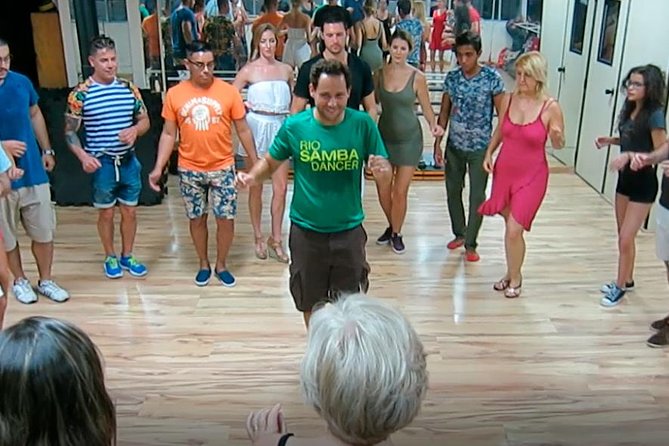
The meeting point is Av. Nossa Sra. de Copacabana, 807, room 603, in Copacabana, Rio de Janeiro. The studio occupies the sixth floor of a mixed office building on a main road, not a grand street-level dance hall.
That detail matters. If you are expecting a colorful storefront with music spilling onto the pavement, you could walk past the entrance. Look for the building doorway and use the instructions sent after booking. One participant specifically found the studio harder to spot because it was inside a professional office block.
The address is practical once you know where you are going. Copacabana is well served by public transportation, and the studio is also reachable by taxi. Transportation to and from the class is not included, but most people will not need a special transfer. Allow a little extra time to find the entrance, get upstairs, and settle in.
You will meet the instructor at the studio. The activity ends at the same place, so you are free to continue exploring Copacabana afterward. This makes the class easy to pair with other plans instead of treating it as a major half-day commitment.
More Copacabana and Ipanema days:
- Rio de Janeiro: Beginner Samba Lesson in Ipanema
★ 4.9 · 1,071 reviews - Rio de Janeiro: Samba Class in Copacabana
★ 4.6 · 262 reviews - Rio de Janeiro: Stand-Up Paddle – Copacabana Beach Sunrise
★ 3.7 · 39 reviews
The first steps: a gentle start for beginners
The lesson begins with the basics. That sounds simple, but it is exactly what many first-time dancers need. Samba has a quick, precise rhythm, and beginners can feel awkward if an instructor starts with a full routine. Here, the teaching is generally broken into manageable movements and repeated until the group can follow.
Several instructors have received especially warm praise for their energy and clarity. Marcos was described as an excellent instructor, while Carmen was praised for giving students a solid workout without losing the fun. Carla has also been singled out as a strong teacher who introduces what students considered real samba, rather than a generic ballroom version.
The teaching style can vary by instructor. Bem Vind received praise for counting each step, explaining the accent of the movement, and stopping to help when a student needed another try. His lesson included forward and backward movement, turns, and work across the floor. That suggests the class can be more than a quick party trick. You may get a genuine crash course in samba technique.
At the same time, this is still a group class designed for a broad range of ability. You should not expect a private lesson with a custom plan. Some people may pick up the rhythm quickly, while others will need more repetition. The instructors appear used to mixed groups, including complete beginners, older and younger adults, couples, and people who are not naturally comfortable dancing.
That broad mix is part of the appeal. You are not expected to arrive looking like a carnival performer. The class is built around participation, not perfection.
An active hour with repetition, movement, and music
The class is listed at about one hour, though the exact length can vary. One participant described a session that lasted about 45 minutes. That may be unusual, but it is worth keeping in mind if you are booking around a tight schedule.
A typical lesson moves from basic footwork into repeated combinations. You might practice while facing the instructor, then travel across the room, add turns, or work backward and forward. The structure gives you something to concentrate on instead of simply copying a fast routine all at once.
The activity can also be a real workout. One student called it sporty, and another said the class provided a good physical effort while still teaching useful steps. Wear comfortable clothing that lets you move freely. Shoe requirements may not be strict. One session was done barefoot, and the instruction was not to worry too much about footwear.
Because the class is physical, take advantage of the bottled water provided. If you prefer not to dance barefoot, ask the instructor what is suitable when you arrive. The available information does not promise a particular shoe policy for every session.
Music is central to the mood. One instructor shared a playlist after class, which is a thoughtful extra if you want to keep the samba feeling going after you leave. That is not listed as a guaranteed inclusion, so treat it as an instructor-specific bonus rather than part of the formal package.
Daytime costumes and a taste of Carnival
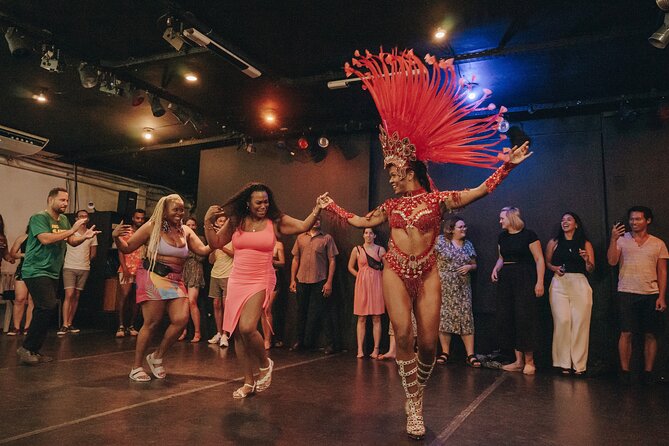
A daytime samba class may let you try a carnival costume. This adds a visual, playful element to a lesson that otherwise focuses on steps and rhythm.
The costume option is useful for two reasons. First, it gives you a small connection to the public face of Brazilian Carnival. Second, it can help shy participants relax. Once everyone is laughing, posing, and trying to keep time, the class feels less like an examination of your dance ability.
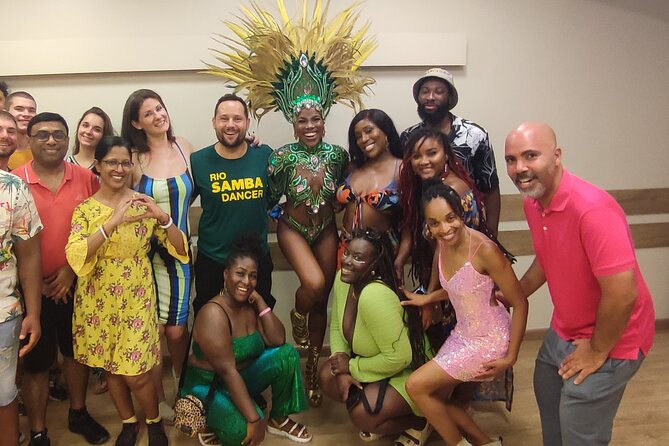
Photos and videos may also be taken during some sessions. Carla, for example, was praised for making photos and videos during the dancing and afterward with flags and a samba costume, then sharing them with the group. Again, this appears to depend on the instructor and class, so do not book solely on the assumption that professional photos are included.
The costume is not a replacement for learning. The strongest part of the activity remains the instruction itself. Think of the outfit as a fun cultural touch, not the main event.
More samba nights:
- Rio: Pub Crawl in Lapa with Cachaça Tasting and Live Samba
★ 4.7 · 881 reviews - Rio: Carnival Backstage Tour at Samba City with Cocktail
★ 4.6 · 520 reviews - Hop-ON Hop-OFF Sightseeing Bus in Rio de Janeiro – Rio Samba Bus
★ 3.5 · 457 reviews - Santa Teresa, Lapa, and Cinelândia with Tram Ride and Selarón Steps
★ 4.5 · 274 reviews
Why the social side works for solo visitors
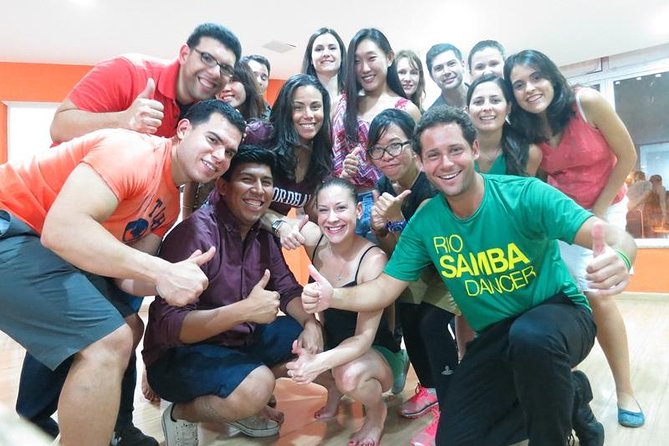
I can see why this class suits solo visitors. You do not need to bring a partner, and the instructor encourages interaction among people in the group. That makes the hour less intimidating than walking into a nightclub alone and trying to learn by watching everyone else.
The class also works well for couples. You can dance together, but you are not locked into partner work. The mixed setup lets each person learn at their own pace while still sharing the activity.
Friends can enjoy it for the same reason. The hour creates an easy shared story, especially if one person in the group is nervous about dancing. The class does not require you to be young, athletic, or naturally coordinated. One participant who described himself as hesitant to try samba said the instructor made it feel easy and enjoyable.
Do not confuse social with guaranteed crowd energy, though. One class had only a few students, while another became too crowded. A small class can mean more attention from the instructor and a quieter lesson. A fuller class may feel more festive, but it can also make it harder to see or move.
If you specifically want a large group party, ask how many people are booked before you arrive. If you prefer close instruction, ask the same question for the opposite reason.
Language and teaching quality
The activity may be led by a multilingual guide, but English ability can vary. One student had a fun class with an energetic instructor who did not speak English, which meant that instructions were typed into a translation tool for part of the lesson.
That is the clearest practical weakness in the experience. Samba can be taught through demonstration, but precise explanations help, especially when the rhythm and foot placement are new. If you need detailed verbal instruction in English, confirm the language of the scheduled instructor before booking.
The positive side is that many of the steps can be shown rather than explained. Several instructors have been praised for clear, professional teaching. Bem Vind used counts and repeated movements carefully, while other teachers were applauded for humor, patience, and high energy.
You should also remember that the class may be operated by a multilingual guide, not necessarily an English-only instructor. If language is important to you, contact the provider in advance and ask for an English-speaking teacher. The provider has indicated that it is working with a group of instructors that includes English speakers.
Crowding, timing, and the Carnival period
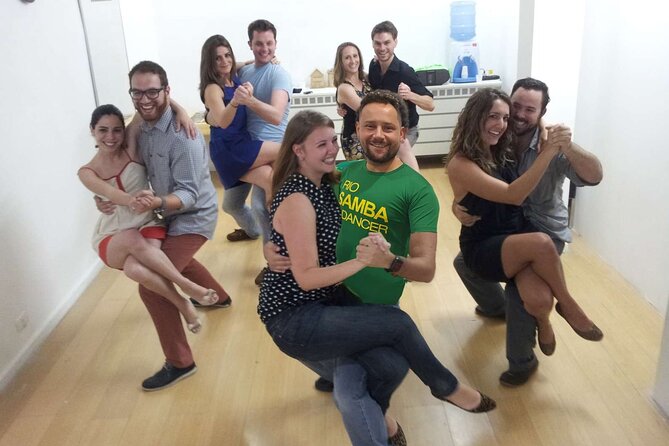
The maximum group size is 50 people. That is a fairly large ceiling for a physical dance class, where everyone needs enough room to watch, turn, and move across the floor.
Most of the available feedback points to a comfortable and enjoyable class, but one late-December session became crowded even after moving to a larger space. The provider has indicated that it plans to use a bigger studio during the end-of-year and Carnival period, while regular classes during the rest of the year generally run with more room.
My advice is simple: if you are visiting in late December, around Carnival, or during another busy period, ask about the expected number of students. This is especially important if you have limited mobility, want close correction, or dislike crowded rooms.
The class is otherwise easy to fit into a Rio schedule. At roughly one hour, it can sit between major sights or work as a late-morning or afternoon activity. Daytime sessions may offer the costume option, so check the class time if that feature interests you.
Is $35 a fair price?
At $35 per person, the class is not the cheapest possible way to hear samba music in Rio. You are paying for a guided lesson, a professional studio, bottled water, and a structured introduction to a dance that is difficult to learn from casual observation alone.
I think the price works best for three types of visitors. First, it is good value if you want an organized cultural activity without committing to a long workshop. Second, it makes sense if you are traveling alone and value an easy social setting. Third, it is worthwhile for couples or friends who want to do something more active than another sightseeing stop.
The value drops if you only want a party atmosphere. One participant expected a larger crowd and left before the class began after realizing it was a bona fide dance lesson. You should book this as an actual class with fun around it, not as a samba show.
The included water and guidance are helpful but not the main reason to pay. The real value is the chance to receive direct instruction, practice the basic rhythm, and learn a little about Brazilian samba culture in a short session.
Who should book this samba class?
I would recommend it to beginners, solo visitors, couples, and friends who want a light cultural activity in Copacabana. It also suits people who normally avoid dance classes. The instructors appear comfortable working with mixed ability levels, and the steps are designed to be approachable.
It is a good choice if you want to learn rather than watch. The class may include history or cultural background, but the focus is movement. You will be on your feet, repeating steps, and trying to keep the rhythm.
More experienced dancers can still enjoy it, especially in a small class. One trained dancer found samba challenging despite a background in ballet and modern dance, which is a useful reminder that samba has its own technique. Do not assume that general dance experience makes the class effortless.
You may want to reconsider if you need a guaranteed English-speaking instructor, a private lesson, or a perfectly spacious room during a peak travel date. Those concerns do not rule out the activity, but they are worth confirming before payment.
Booking, cancellation, and practical details
Confirmation is provided at booking. Free cancellation is available if you cancel at least 24 hours before the scheduled start time. Changes or cancellations made less than 24 hours ahead are not accepted for a refund.
The activity requires a minimum number of participants. If that minimum is not met and the class is canceled, you will be offered another date or experience, or a full refund. Children must be accompanied by an adult, and most people can participate.
The class is booked, on average, 13 days ahead. That does not mean you must reserve two weeks out, but it is a useful signal for planning. If your Rio dates are fixed, especially around Carnival, booking ahead is sensible.
Final verdict: book it if you want to dance
Book this class if you want a friendly, compact introduction to Brazilian samba and do not mind being a beginner in public. The best parts are the energetic instructors, simple step-by-step teaching, social format, and central Copacabana location.
Ask about group size and the instructor’s language if those details matter to you. Also remember that the studio is on the sixth floor of an office building, and the class may be shorter or more crowded than expected on a busy date.
For $35, this is a good-value cultural activity when you want to do more than look at Rio. You may leave with basic steps, a better sense of samba’s rhythm, and a few amusing memories of trying to keep your feet under you.
FAQ
How long does the samba class last?
The class lasts approximately one hour. One session was reported as lasting about 45 minutes, so the exact duration may vary.
Where does the class meet?
It meets at Av. Nossa Sra. de Copacabana, 807, room 603, on the sixth floor in Copacabana, Rio de Janeiro.
Does the class end at the same place?
Yes. The activity ends back at the meeting point.
Do I need a dance partner?
No. You do not need a partner to attend.
Do I need previous dance experience?
No. The class is suitable for people without prior dance experience and can be adapted to different ability levels.
Is transportation included?
No. Transportation to and from attractions is not included. The studio is near public transportation and can also be reached by taxi.
Can children attend?
Yes, but children must be accompanied by an adult.
Is the class taught in English?
The class may be operated by a multilingual guide, but the instructor’s language can vary. Confirm English instruction in advance if you need it.
What is the cancellation policy?
You can cancel at least 24 hours before the start time for a full refund. Cancellations or changes made less than 24 hours before the start time are not accepted for a refund.
More Workshops
- Rio de Janeiro: Samba Class and Samba Night Tour
★ 4.6 · 115 reviews - Rio: Caipirinha Workshop and Samba Class
★ 4.8 · 113 reviews - Surf lessons: in Arpoador in Ipanema.
★ 4.7 · 35 reviews - Surf lessons with local instructors in Copacabana/ipanema!
★ 3.6 · 31 reviews
Just added around Rio de Janeiro
- Pedra Bonita Trail: The easiest trail with a beautiful view of Rio★ 4.6 · 3 reviews
- Rocinha Jeep Tour: A Journey into the Soul of the Favela!★ 3.8 · 3 reviews
- Rio: Private, Custom express, Main Attractions!★ 5.0 · 3 reviews
- Rio: Favela Walking Tour of Rocinha with a Resident Guide★ 4.7 · 3 reviews
- Rio: Museum of Tomorrow, Yup Star & Olympic Boulevard★ 3.7 · 3 reviews
- Explore Fernando de Noronha: 7-Hour Ilhatour★ 4.9 · 3 reviews
- Rio: Best Dive Experience All Inclusive Scuba Diving Package★ 5.0 · 3 reviews
- Rio de Janeiro by Air: 10-Minute Helicopter Tour★ 4.4 · 3 reviews
Copacabana & Ipanema Tours, compared.



Surf lessons with local instructors in Copacabana/ipanema!
Read our review →

Bossa Nova and the Carioca life – Copacabana and Ipanema
Read our review →
Browse the lists this tour appears in