
Reviewed · CYCLING TOURS
Bike Tour of the 4 Scales of Lucio
See Brasília beyond the postcards. This seven-hour bicycle tour links Oscar Niemeyer’s famous buildings with Lucio Costa’s planned neighborhoods, parks, shopping streets, and working city. I especially like the chance to ride through Superquadra Sul 308, a model residential block, and the way the route connects grand civic architecture with ordinary Brasília. The main drawback is the length: seven hours in the saddle can be demanding, and the bike selection may not suit every rider.
The tour costs $97.03 per person and is limited to 15 people, which keeps the group manageable for city riding. Guides such as Romain, Larissa, Rui, and Daniel have all received praise for their care and explanations. I would ask about bike fit in advance, especially if you are short, and remember that lunch is not included.
In This Review
- Five things that make this Brasília bike tour different
- Why a bicycle is the right way to read Brasília
- The TV Tower begins the story at street level
- Clube do Choro adds music to the modernist plan
- Sarah Kubitschek Park brings in the green scale
- SQS 308 explains the residential scale
- Igrejinha shows Niemeyer and Athos Bulcão working together
- Itamaraty and Brasília’s central monuments
- South Commercial Sector reveals Brasília in daily use
- Three Powers Square is Brasília at full scale
- The final monuments complete the central axis
- Is $97.03 good value for seven hours?
- Who should book this ride?
- FAQ
- How long does the Bike Tour of the 4 Scales of Lucio last?
- How much does the tour cost?
- What is included in the tour?
- Is lunch included?
- Can children join the bike tour?
- Where does the tour start and finish?
- Should you book the Four Scales of Lucio tour?
Five things that make this Brasília bike tour different
- Four urban scales in one ride: See Lucio Costa’s residential, monumental, civic, and green ideas working together across Brasília.
- A model superblock: SQS 308 reveals how apartment blocks, shops, schools, gardens, and open space fit into the city plan.
- Architecture from the saddle: Reach Niemeyer landmarks such as the Cathedral, Itamaraty Palace, the National Congress, and the Three Powers Square without being sealed inside a car.
- More than monuments: The route includes the TV Tower Craft Fair, South Commercial Sector, pharmacies street, cultural venues, and a working hospital district.
- A long but useful orientation: Seven hours gives you a broad first look at Brasília, though the bikes and physical demands deserve careful thought.
- Family equipment is available: An articulated tandem passenger trailer or bike can be requested for children from about 4 to 10 or 12 years old.
Why a bicycle is the right way to read Brasília
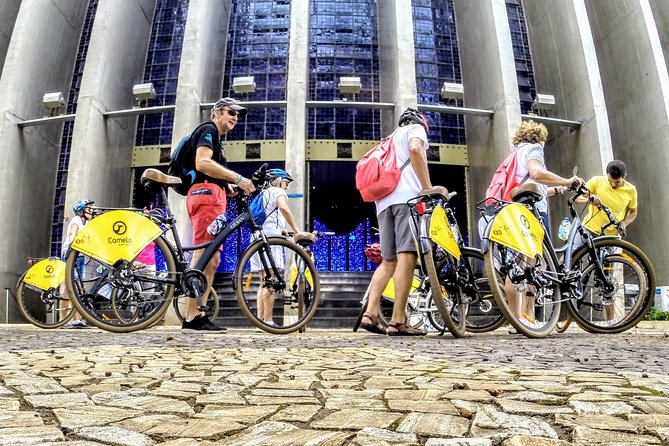
Brasília is not a city that reveals itself in one famous building. Its real subject is the plan: broad avenues, separated districts, apartment superblocks, monumental government spaces, and large areas of greenery. From a car, those pieces can feel scattered. On a bicycle, you move slowly enough to notice how they connect.
That is the point of the Four Scales of Lucio tour. Lucio Costa’s original plan divided Brasília into different kinds of urban life. The residential scale appears in the superblocks. The monumental scale gathers the major government buildings. The civic or communal scale appears in shopping and cultural districts. The green scale is represented by parks and open areas.
You are not simply ticking off buildings. You are seeing how an entire capital was designed from a blank stretch of land. That makes the ride useful for first-time visitors who want context rather than a quick photo stop.
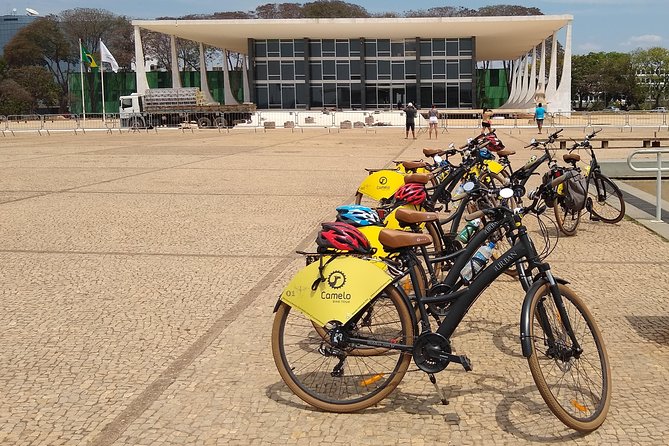
The route begins at Camelo Bike Tour in the Brasil 21 business center in Asa Sul. The experience returns to the same meeting point. Bicycle use, two 500-milliliter bottles of mineral water, and a helmet are included. Helmet use is not mandatory in Brazil, but I would wear one for a full day of city riding.
More bike days:
- São Paulo: Downtown Historical Bike Tour
★ 4.9 · 191 reviews - Rio de Janeiro: Guided Bike Tours in Small Groups
★ 4.5 · 133 reviews - Fatima Neighborhood and Church Unit Bike Tour
★ 5.0 · 58 reviews
The TV Tower begins the story at street level
The first stop is the Television Tower pilotis, where you have about 30 minutes. The tower is a practical starting point because it helps you get your bearings in the central part of the city.
Afterward, the route passes the TV Tower Craft Fair. This adds a useful human touch before the tour turns toward architecture and civic spaces. A fair and a major city landmark occupy the same broad central setting, reminding you that Brasília is not only a collection of official buildings.
This early section also gives you time to settle onto the bicycle. The tour operators spend time checking fit, a worthwhile step before a long ride. That matters here because one of the weaker points reported about the experience is the limited selection of bicycles. Two short riders had difficulty finding suitable bikes, and another rider felt some bicycles needed improvement.
I would contact the operator ahead of time if you need a particular frame size. That simple question may prevent an uncomfortable day.
Clube do Choro adds music to the modernist plan
The next named stop is Clube do Choro, with about 20 minutes to look around. The concert hall was designed by Niemeyer and holds around 500 people. It also houses the Raphael Rabello Choro School.
The school is a special detail. More than 1,000 students study instruments there, including cavaquinho, mandolin, tambourine, guitar, saxophone, flute, accordion, harmonica, violin, and viola caipira. That makes this more than another Niemeyer building. It is a working cultural center with a strong Brazilian musical identity.
The venue gained another curious chapter when Paul McCartney gave a surprise intimate concert there on November 28, 2023. You should not expect a performance during the bike tour, but knowing that the stage has hosted such an unusual event gives the stop extra character.
Nearby, you also pass the Ulysses Guimarães Convention Center. Its original design came from architect Sérgio Bernardes, not Niemeyer. The center contains five auditoriums and 13 modular meeting rooms in a 54,000-square-meter complex with room for 9,400 people at once.
The contrast is useful. Brasília’s architecture is not only about its two best-known planners. The route introduces a wider group of designers and shows how the capital functions as a place for government, business, culture, and public gatherings.
Sarah Kubitschek Park brings in the green scale

Parque da Cidade Sarah Kubitschek is one of the world’s largest urban parks, and the tour allows about 25 minutes there. After so many hard-edged buildings and wide civic spaces, the park gives the ride a different rhythm.
This is the green scale of Brasília’s plan. The park is not a decorative patch placed between monuments. It is a major part of the city’s structure and daily life. The route also passes Renato Russo Hall, adding another cultural reference to the park area.
The stop is brief compared with the park’s size, so do not expect an exhaustive visit. Its value lies in seeing how much open space the city plan protects. You get a better sense of Brasília’s proportions than you would from a building-by-building tour.
A few more trips worth weighing up before you book
- Civic, Legal and Architectural Citytour
★ 4.5 · 81 reviews - Private city tour in Portuguese, English and Spanish.
★ 5.0 · 73 reviews - City Tour Brasilia
★ 5.0 · 40 reviews - Pirenópolis, the charming baroque city inaugurated in 1723 in the gold cycle
★ 4.5 · 40 reviews
SQS 308 explains the residential scale
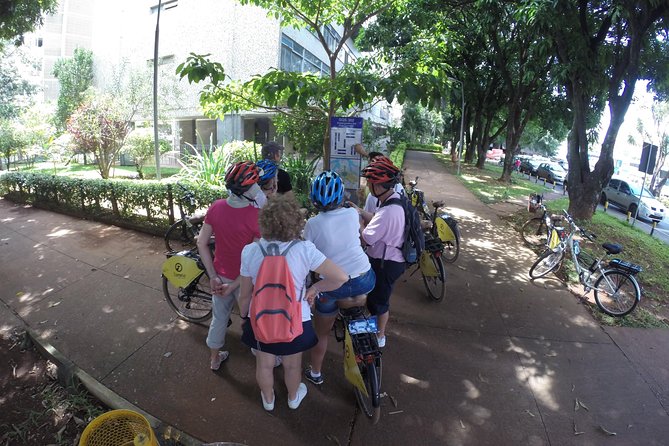
For me, the most important stop is SQS 308, the model superquadra in Asa Sul. You have about 45 minutes here, the longest scheduled pause on the route.
Lucio Costa designed this court as a model residential block. Burle Marx handled the urbanism and landscaping, and Banco do Brasil built it. It opened on February 19, 1962.
A superquadra is not simply a group of apartment buildings. Its design includes building projections, local shops, schools, leisure areas, and open space. The idea was to keep housing within a larger, organized neighborhood rather than create isolated apartment towers beside traffic-heavy roads.
This is where Brasília begins to make practical sense. The monumental buildings are memorable, but the superquadras explain how people were meant to live in the new capital. You can look at the buildings, trees, pathways, and service areas as parts of one plan.
The route also visits Superquadra Sul 302, with about 15 minutes there. It is not the original model block, but its arrangement is similar. Seeing both helps you compare the ideal example with a related residential pattern.
If you have only one day in Brasília, this part is worth protecting. Many sightseeing routes rush from the Cathedral to the Congress and skip the neighborhood plan that gives those buildings their setting.
Igrejinha shows Niemeyer and Athos Bulcão working together
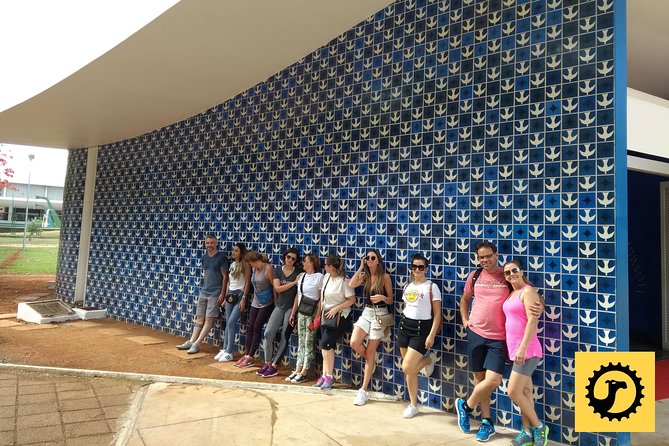
The Nossa Senhora de Fátima Church receives about 20 minutes. Known locally as Igrejinha, it opened in June 1958 and was the first church in the residential sector.
The church was built at the request of Dona Sarah Kubitschek after her daughter recovered from an illness. Its exterior walls carry Athos Bulcão’s tile panels, with stylized images of the dove of the Divine Spirit and the Star of the Nativity.
This is a small building, but that is part of its appeal. It offers a more intimate view of Brasília’s design than the enormous government complexes. The church also shows how architecture and decorative art were joined in the early capital.
Itamaraty and Brasília’s central monuments
The ride continues to Palácio Itamaraty, also called the Palace of the Arches, with about 10 minutes for the stop. It is home to Brazil’s Ministry of Foreign Affairs and is one of Niemeyer’s most recognized works.
The short visit is mainly for viewing the exterior and understanding its place in the central plan. Do not expect a long interior tour as part of this bike experience.
At the Sanctuary of Saint John Bosco, you have about 15 minutes. The sanctuary honors Brasília’s patron saint, Saint John Bosco. It offers another religious counterpoint to the Igrejinha, though the two churches belong to very different scales and moods.
The Metropolitan Cathedral follows, with about 15 minutes. Designed by Niemeyer, it helped establish Brasília as a major setting for modern architecture. Its bold form is one of the city’s defining images, but seeing it in sequence with the smaller Igrejinha makes the architectural story more interesting.
The route also passes Rua das Farmácias, a commercial street dominated by pharmacies because of its location near the South Medical and Hospital Sector. It is a minor stop in the usual sightseeing sense, but it helps you see the city as a place of services and work, not only ceremonial architecture.
South Commercial Sector reveals Brasília in daily use
Praça do Povo in the South Commercial Sector was renovated in 2021. The project won a regional award from the Brazilian Institute of Architects in the urbanism, planning, and cities category.
The square now accommodates skateboarding, shows, and kiosk areas. That mix matters because it shows public space being adjusted for actual use. Brasília’s original plan can feel formal and monumental, but places such as this reveal a city adapting over time.
You spend about 30 minutes in the South Commercial Sector. During the workweek, this area carries a large pedestrian flow because of its services and institutions. Its closeness to the bus station and the Esplanade of Ministries adds to the movement.
This is the communal scale in action. The district has buildings by important architects, including Lelé and Niemeyer, but its real interest comes from the people using it. The contrast with the quiet monumental axis is one of the strongest parts of the tour.
The route also passes the Sarah Hospitals Network’s first unit, a rehabilitation center focused on locomotion and orthopedic conditions. Architect João da Gama Filgueiras Lima, known as Lelé, designed the hospital with large, airy interiors, natural ventilation, and natural light.
The building was planned to make long stays more comfortable. Vierendeel beams, terraces, and garden areas shape the main building. Lelé’s work adds an important lesson: Brasília’s architecture includes careful construction methods and humane public buildings, not only dramatic curves and concrete forms.
Three Powers Square is Brasília at full scale
The tour reaches Praça dos Três Poderes for about 20 minutes. Lucio Costa created the civic plan and Oscar Niemeyer designed many of its buildings. The square opened on April 21, 1960, the same day Brasília became Brazil’s federal capital.
This is the heart of the monumental scale. The square brings together the executive, legislative, and judicial branches of government. Its size and clean geometry were meant to give the new capital a powerful civic center.
Espaço Lucio Costa sits underground beside the square and receives about 15 minutes. It contains a model of Brasília and a tactile model of the Plano Piloto. These models are especially useful because the city is hard to understand from ground level alone.
Seeing the plan in miniature helps you connect the superblocks, monumental axis, commercial sectors, and open areas. If you are interested in urban design, this may be the most informative stop of the entire day.
The route then passes Brasília Classic Mall and the Supreme Federal Court. The court occupies one vertex of the Three Powers Square, opposite the Planalto Palace, and was designed by Niemeyer with the original design tied to Lucio Costa.
The final monuments complete the central axis
The National Theater is another Niemeyer work, and the stop lasts about 10 minutes. The Claudio Santoro National Theater is considered one of Brasília’s most attractive buildings, and its location helps show how cultural institutions were placed within the city plan.
You also pass Cultura Inglesa, Aliança Francesa, Praça 21 de Abril, the Renato Russo Cultural Space at 508 South, and the National Library of Brasília. The Renato Russo space contains rooms, galleries, and theaters, including Teatro Galpão and the renovated Teatro de Bolso.
The route passes the place where the President of the Republic works, then stops at the Pantheon of the Fatherland for about five minutes. The National Congress is also viewed along the way, positioned at the beginning of the Esplanade of Ministries and forming one of the city’s clearest visual markers.
The final named stop is Jardim Burle Marx, with about 10 minutes. The tour then passes along the Esplanade of Ministries before returning to the starting point.
By the end, you have seen the major civic axis, but you have also visited housing, music, healthcare, parks, shopping streets, and public squares. That range is the tour’s real strength.
Is $97.03 good value for seven hours?
At $97.03, this is not the cheapest way to see Brasília. Still, the price includes a bicycle, helmet availability, two bottles of water, a guide, and roughly seven hours of structured sightseeing. You are also covering a very large city area without arranging several taxis or piecing together separate visits.
The value depends on your goal. If you only want quick photographs of the Cathedral and Congress, a shorter car tour may be more efficient. If you want to understand why Brasília looks and works as it does, the bike format earns its price through time, access, and explanation.
The maximum group size is 15 people. That is large enough for a social ride but small enough for a guide to manage crossings and keep the group together. Daniel was praised for helping with crossings and traffic lights, taking photographs, and keeping the explanations lively. Romain was praised for his architecture and history knowledge, while Larissa and Rui were noted for their attentiveness and friendly handling of the day.
The main value warning is the equipment. The operator is working on bike upgrades, but you should ask about frame size and condition before booking. The helmet supply is a plus, though lights were not available for one afternoon tour that extended into evening. The operator has since clarified that lights are available for nighttime tours, but it is still sensible to ask if your ride may finish after dark.
Who should book this ride?
I would choose this tour if you want a serious first look at Brasília and enjoy moving under your own power. It suits people interested in architecture, urban planning, Brazilian culture, public space, and the everyday structure behind the famous monuments.
It also works well for families if you request the child trailer or articulated tandem in advance. Most people can participate, and the activity is near public transportation, but you should be comfortable with a long day of cycling.
I would think twice if you dislike extended rides, need a very specific bicycle size, or prefer spending a long time inside each museum or monument. Many stops are short, and several buildings are viewed from outside. Lunch is not included, so plan for the meal break as part of your day.
Free cancellation is available up to 24 hours before the start time. Poor weather can also lead to a new date or a full refund, since the ride depends on safe conditions.
FAQ
How long does the Bike Tour of the 4 Scales of Lucio last?
The tour lasts approximately seven hours and ends back at the meeting point.
How much does the tour cost?
The listed price is $97.03 per person.
What is included in the tour?
Bicycle use, two 500-milliliter bottles of mineral water, and helmet availability are included. Helmet use is not mandatory in Brazil.
Is lunch included?
No. Lunch at the restaurant is not included in the tour price.
Can children join the bike tour?
Most people can participate, and an articulated tandem passenger trailer or bike is available for children from about 4 to 10 or 12 years old. You need to ask for this equipment in advance.
Where does the tour start and finish?
The tour starts at Camelo Bike Tour, SHS Quadra 06, Conjunto A, Bloco A, Loja 17, Centro Empresarial Brasil 21, Asa Sul, Brasília. It finishes back at the same meeting point.
Should you book the Four Scales of Lucio tour?
Book it if you want Brasília explained as a city, not merely displayed as a set of monuments. The model superblock, South Commercial Sector, Sarah hospital, parks, cultural sites, and government axis give you a much fuller picture than a standard highlight ride.
Before paying, confirm your bicycle size, ask about equipment lights if the ride may reach evening, and prepare for a full day outdoors. With those details handled, this is a strong-value choice for anyone who wants to understand the ideas behind Brazil’s unusual capital while seeing how those ideas meet daily life.
Just added around Brazil
- Idyllic Islands Private Speedboat Tour in Paraty★ 5.0 · 3 reviews
- Pedra Bonita Trail: The easiest trail with a beautiful view of Rio★ 4.6 · 3 reviews
- Campos do Jordão: Full-Day Private Tour from São Paulo★ 5.0 · 3 reviews
- Itacare: Jeribucaçu Trail and Usina Waterfall★ 4.7 · 3 reviews
- Paraty: Half-Day Bike Rental★ 3.6 · 3 reviews
- Walk to the Big Rock in Cantareira State Park★ 5.0 · 3 reviews
- Rio: Private, Custom express, Main Attractions!★ 5.0 · 3 reviews
- Rocinha Jeep Tour: A Journey into the Soul of the Favela!★ 3.8 · 3 reviews
Cycling Tours, compared.

Pirenópolis, the charming baroque city inaugurated in 1723 in the gold cycle
Read our review →Browse the lists this tour appears in